
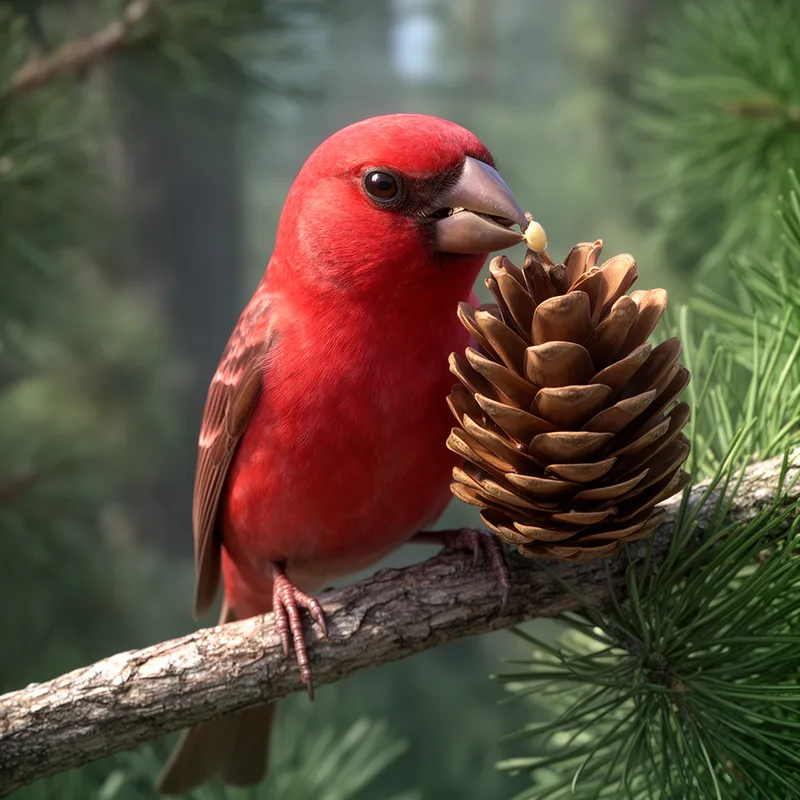
Loxia curvirostra
- noun
- Specialized
- The Loxia curvirostra uses its unusual bill to extract seeds from pine cones.
Examples
-
Researchers studied how the Loxia curvirostra adapts to different conifer forests.
-
The Loxia curvirostra is often found in coniferous forests.
-
A flock of Loxia curvirostra was spotted feeding high in the spruce trees.
-
Did you see the Loxia curvirostra at the park?
-
A flock of Loxia curvirostra was spotted feeding on seeds from conifer cones.
-
The Loxia curvirostra uses its crossed bill to extract seeds from pine cones efficiently.
-
In winter, Loxia curvirostra often forages in mixed conifer forests for food.
Synonyms
 1
9.3

A small bird with a curved beak whose tips cross to open pine cones
Surface Forms
Morphology
Loxia + curvirostra
This is a Latin scientific binomial rather than a compositional English phrase; its constituents are taxonomic/Latin forms not familiar to a B1 learner. Even though elements like curvi- and rostra historically mean 'curved beak', that morphological information is specialist and not accessible to average learners, so the species meaning cannot be derived from the parts.
Etymology
Loxia curvirostra is the scientific name for the small bird called a 'crossbill' because the two parts of its bill cross at the tips. This crossed bill lets the bird open pine cones and pull out the seeds, so the name refers to its special way of feeding.