
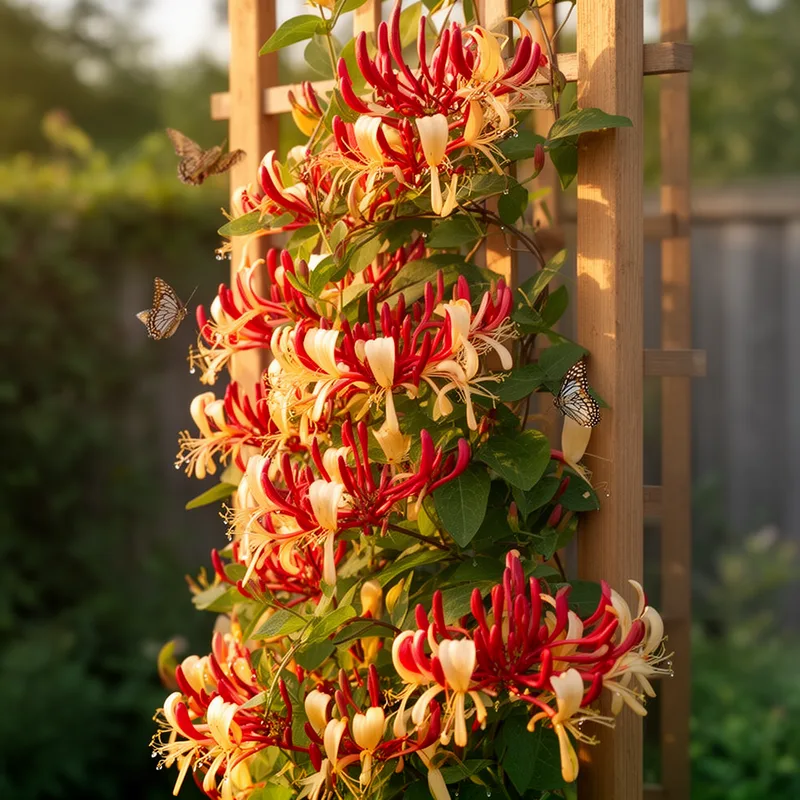
Lonicera periclymenum
- noun
- Specialized
- Gardeners often choose Lonicera periclymenum for trellises because of its beautiful climbing habit and fragrant flowers.
Examples
-
The Lonicera periclymenum in her garden filled the summer evenings with a sweet, intoxicating scent.
-
Many butterflies are attracted to the blossoms of Lonicera periclymenum in late spring and early summer.
-
The Lonicera periclymenum blooms beautifully in the spring.
-
Did you see the Lonicera periclymenum in the garden?
-
Gardeners often choose Lonicera periclymenum for trellises because of its beautiful climbing habit and fragrant flowers.
-
Many butterflies are attracted to the blossoms of Lonicera periclymenum in late spring and early summer.
-
The Lonicera periclymenum in her garden filled the summer evenings with a sweet, intoxicating scent.
Synonyms

 1
9.9
1
9.9

A climbing plant with sweet-smelling red and pale yellow flowers

A climbing shrub that has sweet-smelling white and yellow flowers and red fruit
Surface Forms
Morphology
Lonicera + periclymenum
The form is a taxonomic binomial (genus + species): knowing 'Lonicera' as the honeysuckle genus allows a learner to infer this refers to a kind/species of honeysuckle. However, 'periclymenum' has no accessible dictionary gloss and is a Latin species epithet, so its specific descriptive sense is not derivable by a B1 learner, making the overall expression only partly transparent.
Etymology
Lonicera periclymenum may come from two older names: Lonicera honours a German plant scientist named Adam Lonicer, and periclymenum comes from an old Greek word meaning 'to twine'. So the name suits this honeysuckle because it is a sweet-smelling vine that climbs and 'twines' around fences and trellises.