
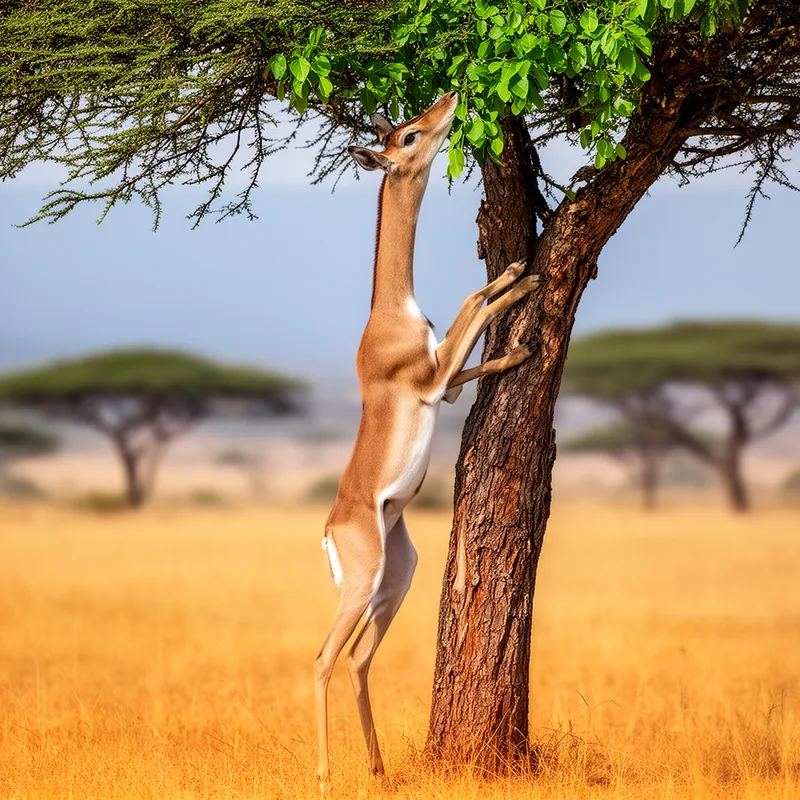
Litocranius
- noun
- Specialized
- The Litocranius is noted for its remarkable ability to stand on its hind legs while browsing for food.
Examples
-
Unlike many other antelopes, the Litocranius can reach foliage that is out of reach for most herbivores.
-
Researchers observed a group of Litocranius grazing among the acacia trees in the savanna.
-
Look at that Litocranius!
-
The Litocranius is often referred to as the gerenuk.
-
A herd of Litocranius was seen gracefully maneuvering through the tall grasses of the eastern African plains.
-
The long neck of the Litocranius allows it to browse on leaves that are high above the ground.
-
In the wild, Litocranius are adept at balancing on their hind legs to reach food inaccessible to other animals.
Synonyms


 1
9.9
A slender East African antelope that stands on hind legs to eat leaves
Compounds
- Specialized
A slender antelope from East Africa with a long neck and backward-curving horns that feeds on leaves high in trees
Surface Forms
Etymology
Litocranius is a scientific name made from Greek parts; you can think of the -cranius part like cranium 'head'. A helpful way to remember it is to picture the gerenuk, a long-necked antelope, standing tall and reaching high leaves with its small head, because the name brings to mind this animal's head-up feeding style.