
Lipan


 1
9.9
1
9.9
- proper noun
- /ˈliːpən/
- The people who are now referred to as the Lipan Apache once hunted and gathered in Texas and northern Mexico.
- Lipan Apache
- Lipan Apaches
- Lipan narratives
Examples
-
Note that the Lipan women are the ones who recognize both the Mescalero and the Lipan word for ghost.
Academic text (1999) -
During the early 1900s, the Mescalero and Lipan groups continued to live in matrilocal settlements along Tularosa, Nogal, Three Rivers, and Elk-Silver creeks.
Academic text (1990) -
The Mescalero used to go down and meet the Lipan.
Academic text (1999) -
The Lipan learned it from the Carrizo before they had any experience with white people or Mexicans.
Academic text (1999) -
Furthermore, one group of Lipan was relocated to Oklahoma with the remnants of the Tonkawa.
Academic text (1999) -
Verne Ray, in his review of historical Apache documents, concludes that the Lipan and Mescaleros had often interacted on "friendly" terms.
Academic text (1999) -
34 Opler, in his preface to his collection of Lipan narratives, points out that since the Lipan had arrived on the reservation, many Lipans and Mescaleros had intermarried.
Academic text (1999) -
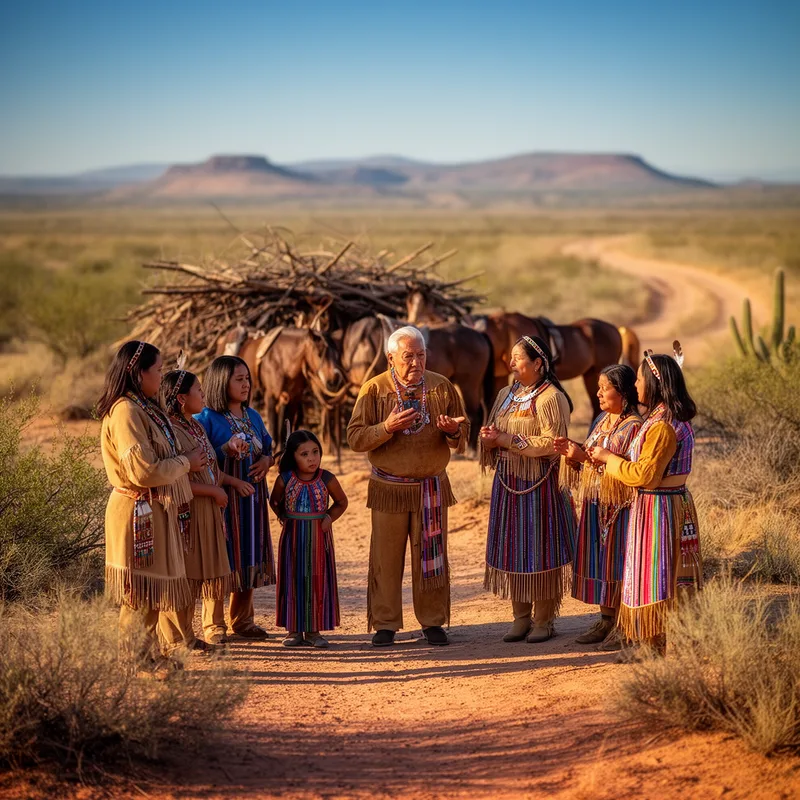
The Lipan Apache people have a rich cultural history that dates back several centuries.
-
Many Lipan Apache families still maintain their traditions and languages in Texas today.
-
Anthropologists study the Lipan to better understand the Native American heritage of the region.
Surface Forms
Etymology
Lipan is the name of a Native American people from Texas and northern Mexico, a name used by Spanish and English speakers to identify that group. So when someone is called a Lipan, it means they belong to that people.