
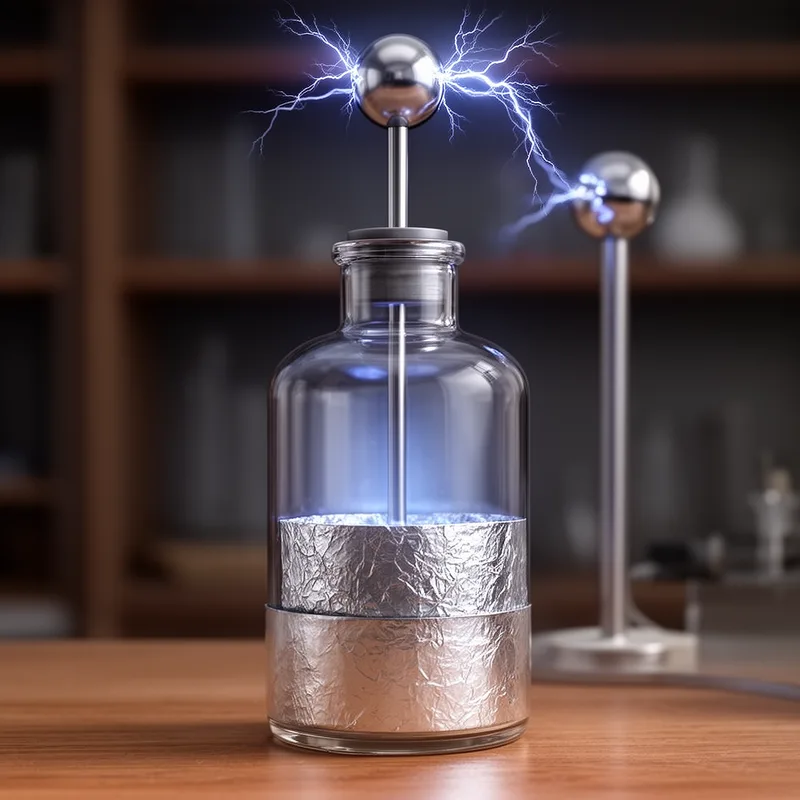
Leyden jar


 1
9.9
1
9.9
- noun
- /ˈleɪdən ˌdʒɑr/
- Specialized
- The scientist carefully demonstrated how to charge a Leyden jar using a static electricity generator.
Examples
-
Running a sequel is rather like trying to capture lightning in a bottle; it's possible (you need a Leyden jar and a kite); in other words, some very specific preparation.
Blog text (14) -
According to the story, in 1752, Franklin went out into a thunderstorm with a kite attached to a key, which was in turn attached to a Leyden jar.
Blog text (31) -
It was more than 80 years since Benjamin Franklin, in 1752, had experimented with static electricity from Leyden jars and with electricity from the sky by flying a kite over Philadelphia during a storm.
Academic text (2000) -
In the laboratory, students learned about the function of a Leyden jar as an early capacitor for storing electrical energy.
-
When the Leyden jar was fully charged, it produced a remarkable spark that surprised everyone in the room.
Synonyms
A glass jar that stores static electricity with metal foil inside and outside

A device that stores electric charge to give out later
Surface Forms
Morphology
This is an eponymous name (Leyden = place name) combined with the common noun 'jar', so a learner who knows the parts would only infer 'a jar associated with Leyden' but not its specific technical function. The meaning 'early device for storing static electricity' is a specialized, historical/technical sense that is not predictable from the constituents, so the expression is opaque to a B1 learner.
Etymology
Leyden jar gets its name from the Dutch city of Leiden (often spelled Leyden), where scientists first made the device in the 1740s. It was a glass jar lined with metal that could 'store' electricity, so the city's name became the name for this early electrical storage device.