

Leucanthemum lacustre
- proper noun
- Specialized
- Unlike the common oxeye daisy, Leucanthemum lacustre prefers slightly wetter habitats.
Examples
-
The wet meadows along the Portuguese coast are home to Leucanthemum lacustre.
-
Gardeners admire Leucanthemum lacustre for its daisy-like blossoms and resilience.
-
The Leucanthemum lacustre thrives in wetland areas.
-
Have you ever seen a Leucanthemum lacustre in bloom?
-
Gardeners admire Leucanthemum lacustre for its daisy-like blossoms and resilience.
-
The wet meadows along the Portuguese coast are home to Leucanthemum lacustre.
-
Unlike the common oxeye daisy, Leucanthemum lacustre prefers slightly wetter habitats.
Synonyms
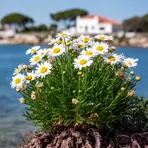
A plant from Portugal with daisy-like flowers that lives many years

A plant that lives many years with white petals and a yellow centre
Surface Forms
Morphology
Leucanthemum + lacustre
This is a Latin binomial (a scientific species name) that functions as a proper noun rather than a compositional English phrase; even though 'Leucanthemum' is glossed as a genus, 'lacustre' is not defined here and is a domain-specific Latin adjective (relating to lakes) that B1 learners are unlikely to know. Scientific names are generally treated as labels and are not transparently interpretable by average learners from their parts, so the expression is opaque.
Etymology
Leucanthemum lacustre is a scientific name made from Greek and Latin words: Leucanthemum means 'white flower' and lacustre means 'of the lake' or 'living in marshes'. So the name gives a simple picture of a white, daisy-like plant that grows in wet places.

