
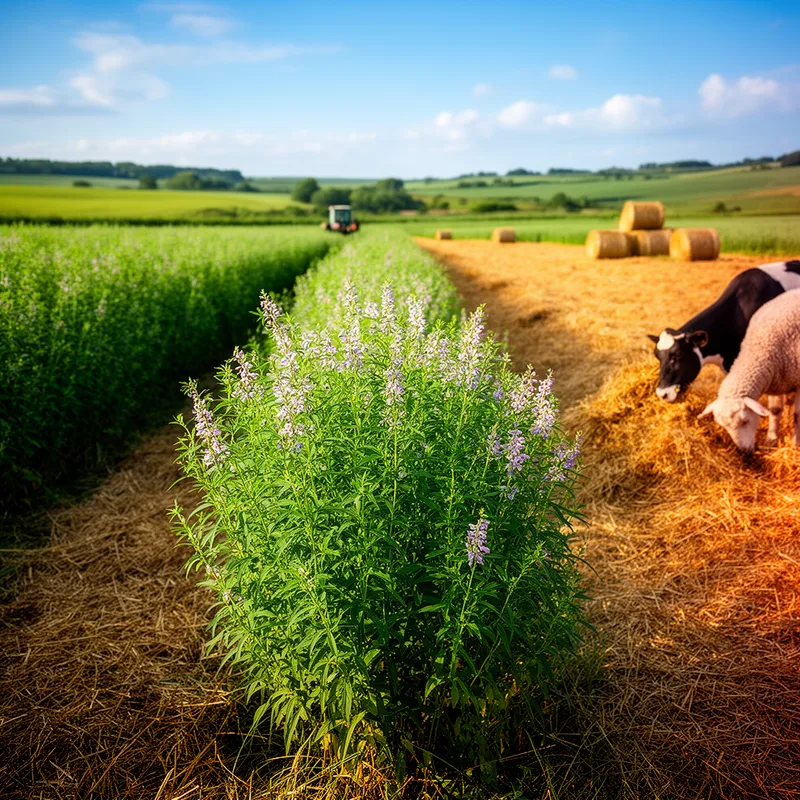
Lespedeza cuneata
- noun
- Specialized
- Some regions use Lespedeza cuneata as an important hay crop for livestock.
Examples
-
The rapid growth of Lespedeza cuneata makes it valuable for preventing soil erosion.
-
Farmers often plant Lespedeza cuneata to restore fertility to overworked soil.
-
Farmers often plant Lespedeza cuneata for its resilience.
-
The Lespedeza cuneata fields were lush this summer.
-
Farmers often plant Lespedeza cuneata to restore fertility to overworked soil.
-
Some regions use Lespedeza cuneata as an important hay crop for livestock.
-
The rapid growth of Lespedeza cuneata makes it valuable for preventing soil erosion.
Synonyms

A plant that lives many years and is grown for hay and animal feed on poor soil

A plant that lives for several years and is grown for animal feed and hay on poor soils
Surface Forms
Morphology
lespedeza + cuneata
This is a botanical binomial composed of a genus name + specific epithet, so a learner who knows 'Lespedeza' (a forage/shrub plant) and the epithet could infer it names a particular species of Lespedeza and therefore a plant. However, the full pragmatic details in the definition (perennial, widely grown for forage/hay on poor land) are not directly derivable from the epithet and require domain knowledge; Latin epithets are often opaque to learners. For these reasons the composition gives partial but not complete predictability.
Etymology
Lespedeza cuneata comes from scientific names: the first word Lespedeza is the plant group and the second word cuneata means 'wedge-shaped', a picture of its small wedge-shaped leaves. Farmers plant Lespedeza cuneata as a tough forage and to help poor soil, so the name gives an easy image to remember the plant and its use.

