
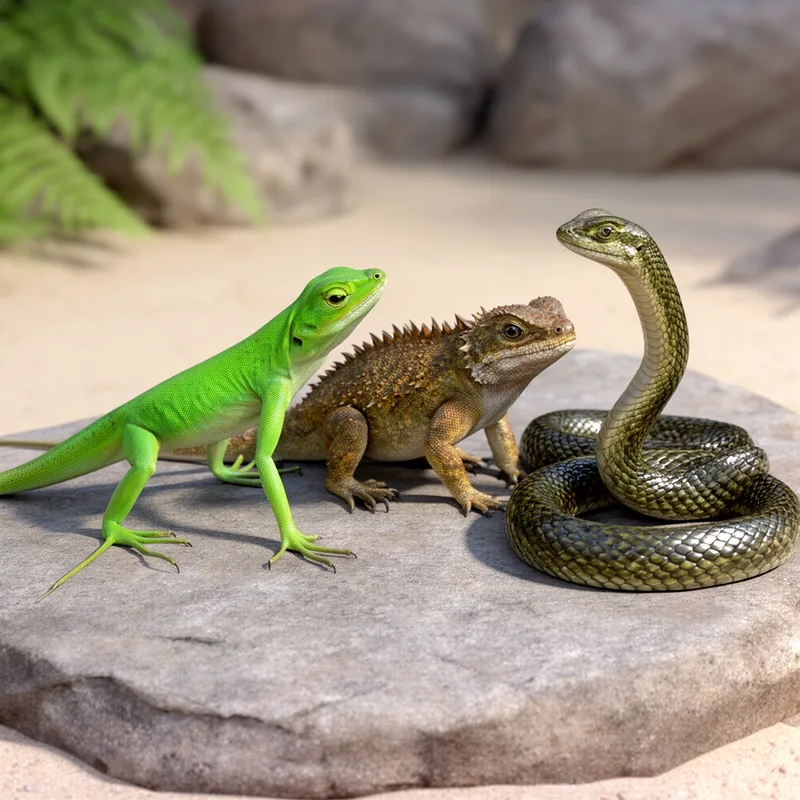
Lepidosauria


 1
9.9
- noun
- /ˌlɛpɪdəˈsɔːriə/
- Specialized
- Scientists often study Lepidosauria to understand reptilian evolution.
Examples
-
The Lepidosauria first appeared in the fossil record during the Mesozoic era.
-
The Lepidosauria group includes many fascinating species.
-
Both lizards and snakes belong to the order Lepidosauria.
-
Many Lepidosaurias are found in tropical regions.
-
Lepidosauria includes various species, such as lizards and snakes, that are adapted to diverse environments.
-
Scientists classify reptiles in Lepidosauria, which encompasses both terrestrial and aquatic species.
-
The study of Lepidosauria reveals fascinating insights into the evolution of reptiles over millions of years.
Surface Forms
Morphology
Lepidosauria = lepido + saur + ia
This is a Latinized scientific name built from Greek combining forms ('lepido-' + 'saur-') plus the taxonomic suffix '-ia'; these combining forms are not productive or recognizable morphemes for an average B1 learner, so the meaning is not derivable from the parts.
Etymology
Lepidosauria comes from Greek parts lepido- 'scale' and -sauria 'lizard'. So it literally means 'scale-lizards', which helps you remember this group of scaly reptiles, like lizards and snakes.