
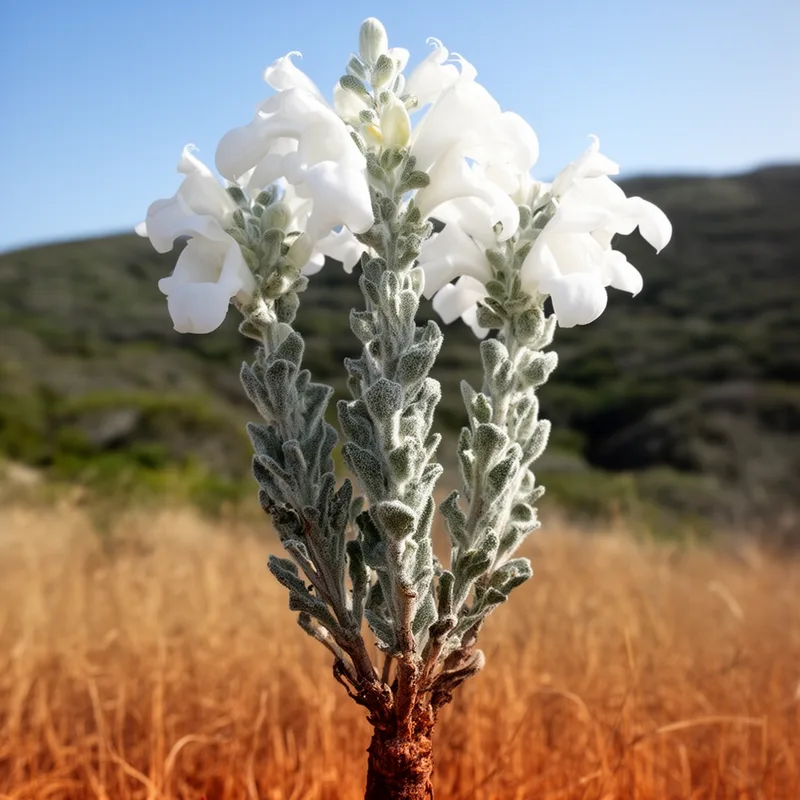
Lepechinia calycina
- noun
- Specialized
- Botanists often refer to Lepechinia calycina as pitcher sage due to its distinctive flowers.
Examples
-
Gardeners appreciate Lepechinia calycina for its aromatic foliage and showy white blooms.
-
Lepechinia calycina thrives in the coastal scrub habitats of California's foothills.
-
The Lepechinia calycina blooms beautifully in the spring.
-
I saw a Lepechinia calycina at the botanical garden last week.
-
Lepechinia calycina is a stunning perennial plant with large white flowers that attracts many pollinators.
-
In California's foothills, Lepechinia calycina flourishes alongside other native species.
-
The aromatic leaves of Lepechinia calycina can enhance both garden aesthetics and culinary dishes.
Synonyms

A plant from California with fuzzy stems and leaves and large white flowers
A California plant with woolly stems and large white flowers
Surface Forms
Morphology
Lepechinia + calycina
This is a Latin binomial (genus + species). Knowing 'Lepechinia' as a plant genus lets a learner infer the phrase refers to a kind of plant, but the species epithet 'calycina' is not a recognizable English lexical item (and its specific descriptive sense is not provided), so the detailed meaning and attributes are not derivable. Because part of the meaning (that it is a plant species) is transparent but the crucial specific sense is not, the expression is only partially transparent to a B1 learner.
Etymology
Lepechinia calycina may be named after a person called Lepechin, while calycina points to the flower's cup-like parts. The flowers and their outer cups look like small pitchers, which is why people call it 'pitcher sage', so the name links to that shape today.

