
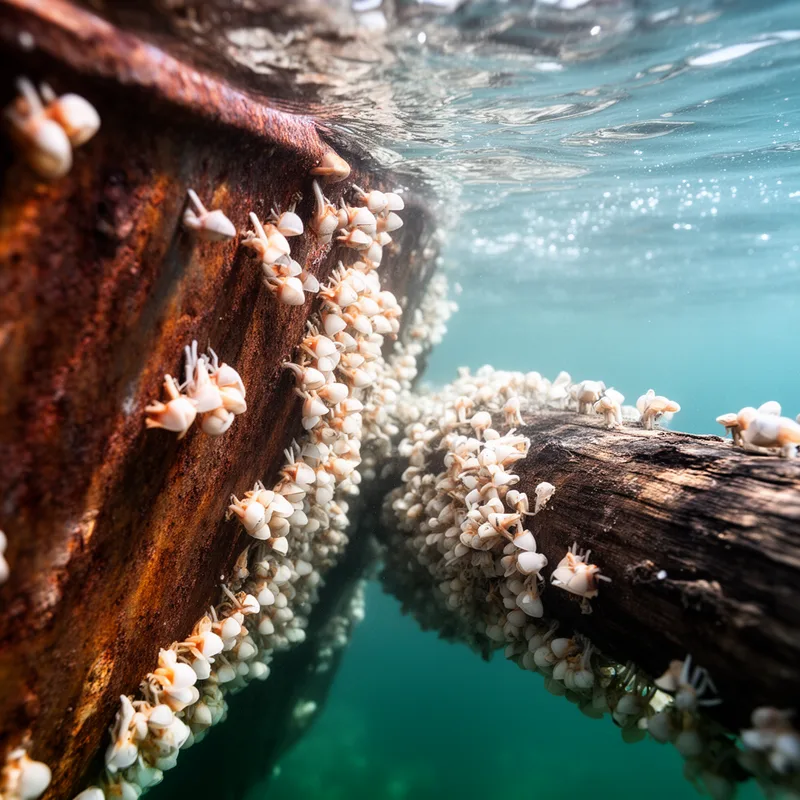
Lepas fascicularis
- noun
- Specialized
- The hull of the old ship was covered with clusters of Lepas fascicularis.
Examples
-
Floating logs washed ashore bearing colonies of Lepas fascicularis barnacles.
-
Marine biologists studied the distribution of Lepas fascicularis in the open ocean.
-
The Lepas fascicularis is often found on ship hulls.
-
Have you ever seen a Lepas fascicularis up close?
-
The hull of the old ship was covered with clusters of Lepas fascicularis barnacles, making it a perfect example of marine life anchoring to vessels.
-
Marine biologists studied the distribution of Lepas fascicularis, a species known for attaching itself to various surfaces in the ocean.
-
Floating logs washed ashore often bear colonies of Lepas fascicularis, indicating their expert ability to cling to drifting debris.
Surface Forms
Morphology
Lepas + fascicularis
This is a scientific binomial (genus + species): a learner who knows 'Lepas' as a genus of stalked barnacles can infer that the phrase names a species of Lepas, so the categorical sense is recoverable. However, 'fascicularis' is a Latin epithet with no obvious, dictionary-level meaning for a B1 learner, and the detailed descriptive content (attachment behavior) cannot be derived from the parts, making the phrase only partly transparent.
Etymology
Lepas fascicularis may come from old words: Lepas for a small sea-shell animal and fascicularis meaning 'small bundle', which gives the image of tiny shells clinging together on floating wood or a ship. That's why the name fits this barnacle with a stalk that lives in clusters on hulls and debris.

