
League of Nations
 5
4.1
5
4.1

- proper noun
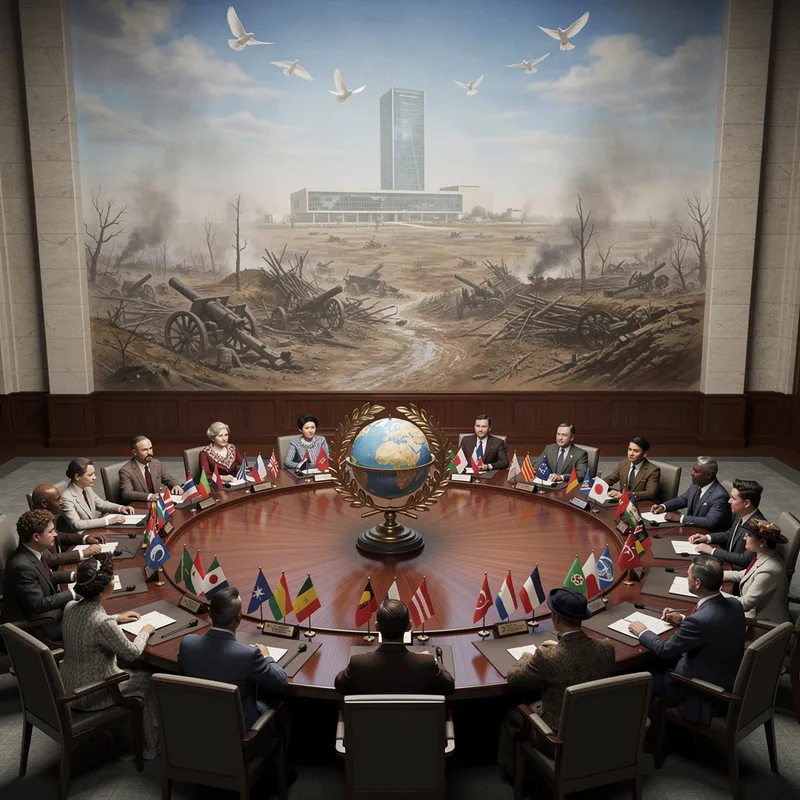
- Following the devastation of World War I, the League of Nations was established to promote international cooperation.
- League of Nations Covenant
- League of Nations Council
- League of Nations mandate
Loading YouTube…
Watch on YouTubeWe created the League of Nations and the United Nations.
- We created the League of Nations and the United Nations.
- after World War One, the League of Nations was formed, which would eventually become the United Nations.
- Now the UNIA did eventually petition the League of Nations calling for Southwest African self rule, but their pleas fell on deaf ears.
Examples
-
after World War One, the League of Nations was formed, which would eventually become the United Nations.
-
After bilateral talks led nowhere, the Bulgarian government appealed to the League of Nations.
Academic text (1995) -
We created the League of Nations and the United Nations.
-
Their economic situation was significantly helped by assistance from the League of Nations.
Academic text (1995) -
Hungary was admitted to the League of Nations in September 1922.
Academic text (1995) -
The committee's draft agreement was submitted in 1930 at a meeting called by the League of Nations.
Academic text (1994) -
The League of Nations promised an international forum for grievances, complete with its own court of law.
-
Roosevelt's plan was a revision of the Covenant of the League of Nations to provide it with greater power.
Academic text (1995) -
Shidehara repeatedly affirmed his confidence in the League of Nations as a mechanism for maintaining world peace.
Academic text (1995) -
The history of Southeastern Europe in the interwar period highlights the League of Nations' predicament.
Academic text (1995)
Surface Forms
Morphology
The meaning 'an alliance/organization of nations' is directly and transparently derived from combining 'league' (an organized alliance) with 'nations' (states or peoples); a learner who knows these words will understand it denotes an organization of countries. Although it is a specific historical proper name (so historical details may not be known), the compositional structure is clear and cross-linguistically familiar, making the phrase understandable to B1 learners.
Etymology
League of Nations was set up after World War I as a group of countries who tried to keep peace. The name shows the idea: league means a group and nations means countries, so it pictures countries joining together to 'prevent wars', which is why the phrase refers to that early international organization.