

Laurentian Plateau
- noun
- The Laurentian Plateau is the largest plateau in Canada, covering a vast area across eastern and northern regions.
Examples
-
Many rivers flow from the Laurentian Plateau into the surrounding lowlands and lakes.
-
The Laurentian Plateau is rich in minerals and has shaped much of Canada's geography.
-
Glacial activity has greatly influenced the landscape of the Laurentian Plateau.
-
The Laurentian Plateau is known for its stunning landscapes.
-
Many wildlife species inhabit the Laurentian Plateau region.
-
Geologists study the unique rock formations found throughout the Laurentian Plateau to understand its history.
-
Visitors to the Laurentian Plateau can enjoy breathtaking views of the forests and lakes that dominate the landscape.
Synonyms


 1
6.5
1
6.5
A large area of very old rocks that form a high, flat land across much of eastern and central Canada
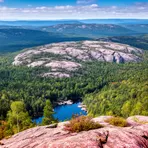
A large area of high rocky land with many forests in eastern and central Canada
Surface Forms
Morphology
Laurentian + plateau
The headword 'plateau' provides the core, compositional meaning (an elevated flat area), and 'Laurentian' functions as a place-name/adjective indicating association with the Laurentian/St. Lawrence region. As a toponymic compound the basic meaning ('a plateau in the Laurentian area') is predictable from its parts, but the precise geographic extent and encyclopedic details are not derivable from the constituents, so it is only partially transparent to learners.
Etymology
Laurentian Plateau gets its name from the nearby St. Lawrence area, Laurentian, and the word plateau, which means 'high, flat land'. Long ago, huge sheets of ice moved over the region and left a wide, rocky high area, so today the name refers to that large high region in eastern and northern Canada.