
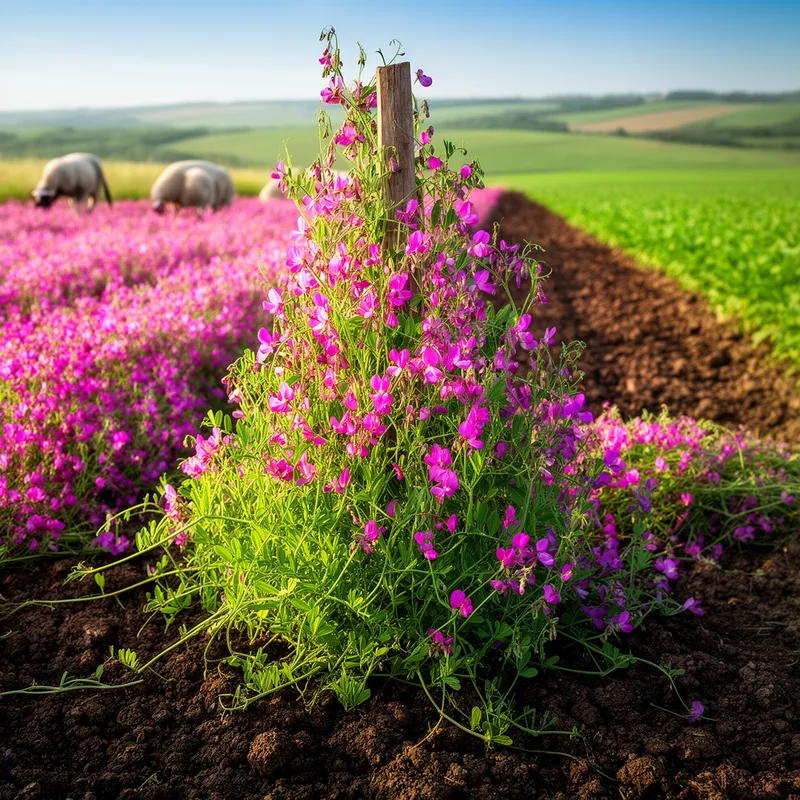
Lathyrus sylvestris
- noun
- Specialized
- The pink and purple flowers of Lathyrus sylvestris attract many pollinators in the summer.
Examples
-
Lathyrus sylvestris is often grown as green manure to improve soil fertility.
-
Some farmers plant Lathyrus sylvestris for use as animal fodder.
-
The Lathyrus sylvestris blooms beautifully in the spring.
-
Farmers often use Lathyrus sylvestris as a green manure.
-
Lathyrus sylvestris is often grown as green manure to improve soil fertility.
-
Some farmers plant Lathyrus sylvestris for use as animal fodder.
-
The pink and purple flowers of Lathyrus sylvestris attract many pollinators in the summer.
Synonyms

A European plant with purple and pink flowers that farmers grow for animal food or to improve soil
A European perennial plant with purple and pink flowers grown for animal feed and to improve soil
Surface Forms
Morphology
Lathyrus + sylvestris
This is a Linnaean binomial formed from a genus name plus a Latin specific epithet: if a learner knew 'Lathyrus' (a climbing pea-like herb) and 'sylvestris' (Latin for 'of the woods' or 'wild'), they could infer it names a Lathyrus species associated with woodland or wild habitats. However, 'sylvestris' is not an English lexical item and the taxonomic naming convention is specialized, so a typical B1 learner without knowledge of Latin/taxonomy would not reliably derive the precise botanical sense.
Etymology
Lathyrus sylvestris may come from old words meaning Lathyrus 'pea' and sylvestris 'of the woods'. Picture a wild pea with pink and purple flowers growing in fields and hedges; that's why the name fits a pea-like wild plant farmers use as animal food and to improve the soil.

