
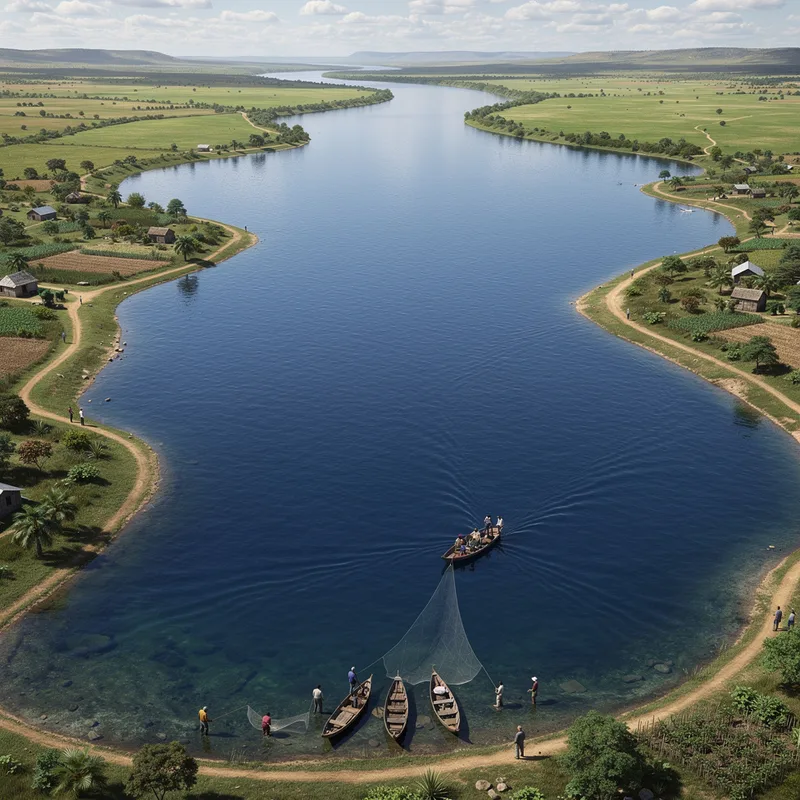
Lake Victoria
 1
2.2
1
2.2

- proper noun
- Lake Victoria itself may have completely dried up only 14,000 years ago (Scholz et al. 1990).
- recent changes in Lake Victoria
Examples
-
Most live from farming cassava and maize and from a growing fishing industry established on the shores of Lake Victoria in recent years.
Academic text (2008) -
To the scientist, the haplochromines of Lake Victoria have a great deal to teach about both speciation and extinction.
Academic text (1992) -
The Lake Victoria Research and Conservation Program picked up where the earlier research left off.
Academic text (1992) -
We know that the same thing can be done in the Lake Victoria region of Tanzania.
Academic text (2008) -
Lake Victoria is now a quarantine area.
-
There is at least an even chance of maintaining a diverse, productive, and healthy tropical ecosystem in Lake Victoria.
Academic text (1992) -
The recent changes in Lake Victoria are astonishing, but they are not without precedent: this lake has a tumultuous past.
Academic text (1992) -
All of the White Nile riparian countries are dependent primarily on Lake Victoria as a source of freshwater, and their dependence on the Nile River for freshwater is not as significant.
Academic text (2008) -
Lake Victoria is Lake Victoria, the largest lake in Africa and a major source of the Nile River.
-
Many tourists visit Lake Victoria to enjoy its beautiful scenery and diverse wildlife.
Synonyms

A very large freshwater lake in Africa also called Lake Victoria that feeds the Nile
Surface Forms
Morphology
lake + Victoria
This is a straightforward compositional place-name: 'lake' supplies the referent class (an inland body of water) and 'Victoria' serves as the identifying proper name. A B1 learner who knows 'lake' and recognizes 'Victoria' as a name will understand it denotes a specific lake (though they would not be expected to know its size or location without extra knowledge), and the generic+name pattern is cross-linguistically common, making the expression transparent.
Etymology
Lake Victoria was named by a British explorer, John Hanning Speke, who called the lake after 'Queen Victoria' when he reached it in the 1800s. That's why the lake still has the queen's name today.