
Lake Erie
 4
1.4
4
1.4

- proper noun
- /leɪk ˈɪəri/
 :
Lago Erie
:
Lago Erie
- Beginning in Lake Superior, for three weeks in July, the team sailed south through Lake Huron and into Lake Erie, collecting water samples as they traveled.
Examples
-
James and his wife, Shelley, live in Avon, a well-off suburb on Lake Erie.
Blog text (8) -
In North Carolina, improvements were made in water quantity and quality, and the cleanup of Lake Erie in Ohio is an ongoing effort.
Academic text (2003) -
The place is on one of the Great Lakes, Lake Erie.
Fiction book (2002) -
Here, you can see the terminus of the legendary waterway and take in some views of Lake Erie.
Blog text (20) -
Beads of microplastic were collected from Lake Erie by Mason and her team.
Blog text (2) -
In the 1940s, you could leave the house after dinner and walk toward Lake Erie across a woods through which ran a creek, and find yourself on the shore of Lake Erie.
Fiction book (1993) -
Another example is the National Shrine of Our Lady of Consolation in Carey, Ohio, about 50 miles south of the western end of Lake Erie.
Academic text (2003) -
The other cases involved watershed protection in North Carolina, an effort to clean up pollution in Lake Erie, and air pollution abatement in Pennsylvania.
Academic text (2003) -
In 1825, a prophetic ceremony took place as the first barge plying the Erie Canal from Lake Erie to the Atlantic Ocean arrived in New York Harbor.
Academic text (1994) -
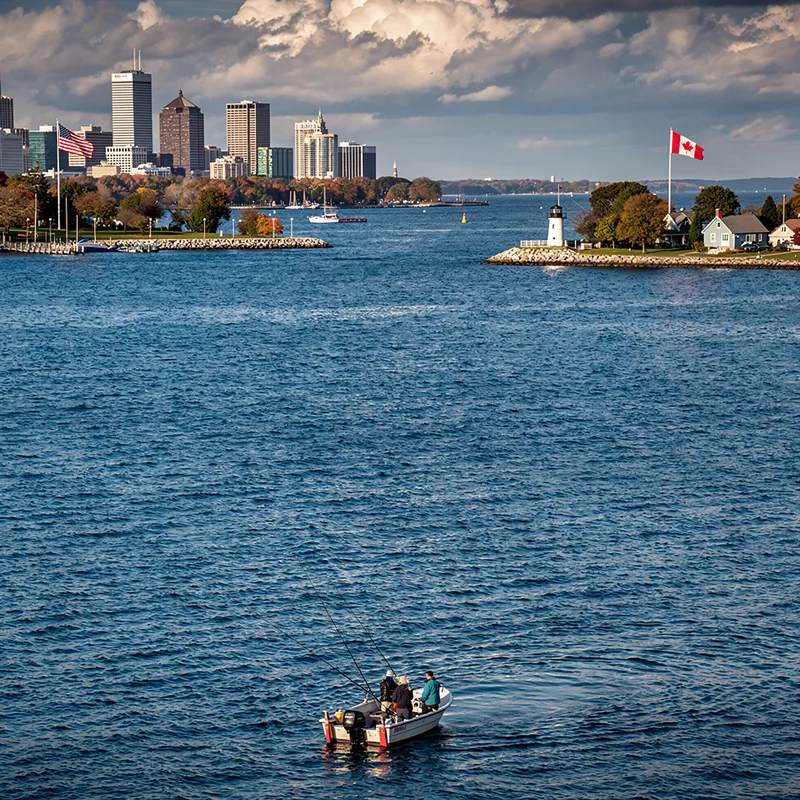
The fourth largest of the Great Lakes, Lake Erie is located on the border between the United States and Canada.
Synonyms
 13
2.3
13
2.3
A large lake between the United States and Canada that is one of the Great Lakes
Surface Forms
Morphology
This is a straightforward toponym formed by the noun 'lake' plus the proper name 'Erie', so a learner who knows both constituents will understand it denotes the lake called Erie. The construction is compositional and follows a common cross-linguistic pattern (place-type + name) rather than an idiomatic or metaphorical shift, so it is immediately comprehensible.
Etymology
Lake Erie gets its name from the Erie people, a Native American tribe who lived near the lake. Their name may come from a word meaning 'long tail', either for an animal or for the long shape of the lake, and that's why the lake is called Lake Erie today.