
Labrador tea
- noun
- /ˈlæbrəˌdɔr ti/
- US
- Researchers are studying the medicinal properties of Labrador tea in traditional remedies.
Examples
-
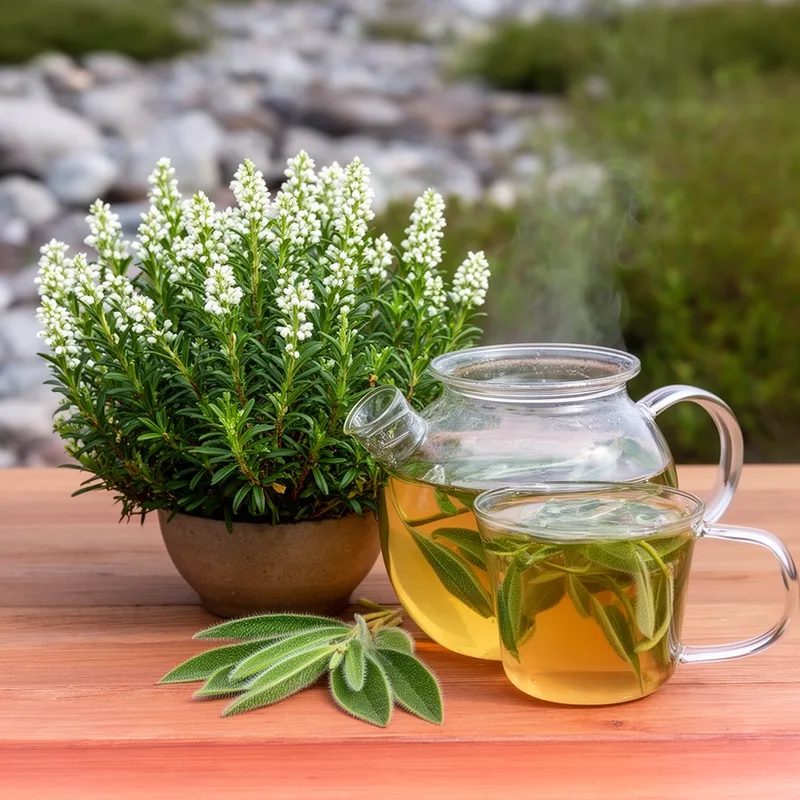
The Labrador tea plant has hairy evergreen leaves and clusters of small white flowers.
-
I brewed some Labrador tea this morning.
-
Early settlers brewed Labrador tea from the leaves during harsh winters.
-
Have you ever tried Labrador tea?
-
I brewed a soothing cup of Labrador tea using the leaves harvested from the shrub in my backyard.
-
In the forest, we found a patch of Labrador tea, its white flowers adding beauty to the landscape.
-
After hiking, we enjoyed relaxing with a warm cup of Labrador tea made from the fresh leaves we picked.
Synonyms

A small evergreen bush with white bell-shaped flowers and dark green hairy leaves

A small evergreen shrub with white bell-shaped flowers whose leaves were used to make tea during the American Revolution
Surface Forms
Morphology
This is a straightforward compound of a place-name (Labrador) + the noun 'tea', so its meaning — a tea or tea-producing plant associated with Labrador — is directly inferable from the constituents. The formation follows a regular English pattern for naming kinds of plants or beverages and involves no idiomatic or metaphoric shift, so a B1 learner who knows both words can readily understand it.
Etymology
Labrador tea comes from a small evergreen shrub that grows in cold places like Labrador, Canada, and people long ago made tea from its hairy leaves to keep warm. So, the name links the place 'Labrador' and the drink 'tea' and now means 'a plant used to make tea'.

