
Kulturkampf


 1
9.9
- proper noun
- /ˈkʊltʊrˌkɑmpf/
- Formal
- In the increasingly polarized politics of 1930s Germany, the fear of a new Kulturkampf, from either the left or the right, deeply affected Catholic perceptions of National Socialism.
- a new Kulturkampf
Examples
-
The galvanizing of Catholic forces during the Kulturkampf of the 1870s had begun a renewal of the political influence of Catholicism in German culture, an influence that would become the subject of critical analysis in the decades to follow, and certainly into the early years of the 20th century.
Academic text (1993) -
As Germany's politics polarized in the early 1930s, and as German Catholics, fearing the weakness of their political position and minority status, sought political allies, the issue of who might prevent or who might bring another Kulturkampf was a central concern.
Academic text (1999) -
Consider these other items from the ongoing Kulturkampf:
Academic text (1991) -
The emerging Kulturkampf between secular and religious groups and the privatization of much of the economy are merely two more issues.
Academic text (1998) -
The public debate about the relationship between religion and culture, which the Enlightenment and political revolutionary movements had set loose and which had become so central to the Kulturkampf rhetoric, had not been settled, nor has it even in our own day.
Academic text (1993) -
Windthorst had been Bismarck's arch-foe and had worked energetically to oppose the Kulturkampf.
Academic text (1993) -
Ever since the original Kulturkampf (the struggle for civilization) of the 1870s, Catholics throughout Germany had been wary of any possible resurgence of legalized anti-Catholic repression.
Academic text (1999) -
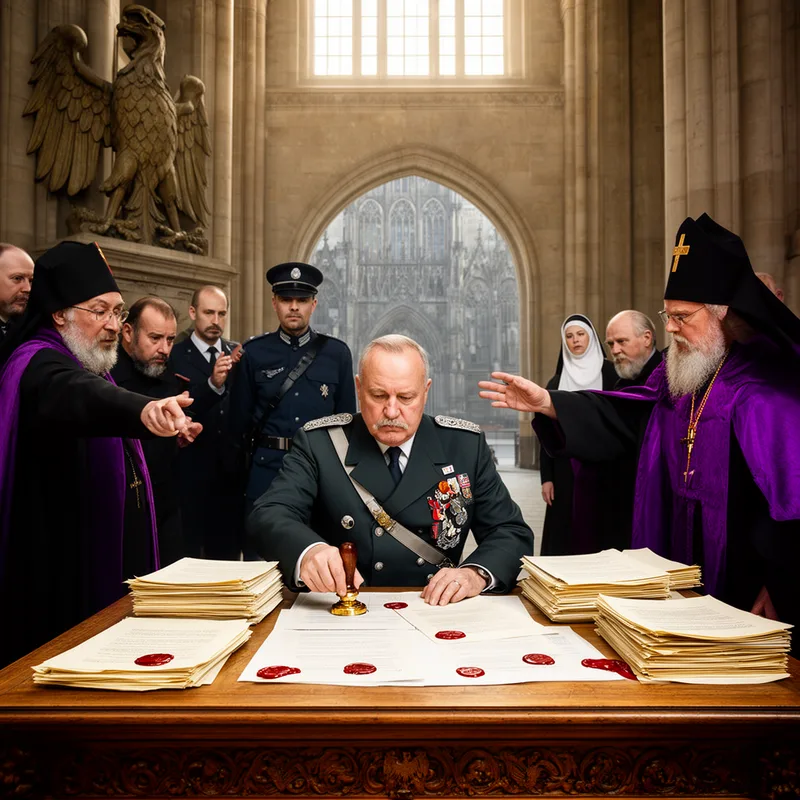
Otto von Bismarck's Kulturkampf was a significant series of policies aimed at limiting the influence of the Catholic Church in Germany.
-
The Kulturkampf in 19th-century Germany highlighted the tensions between secular governance and religious authority.
-
During the Kulturkampf, many Catholic schools faced government oversight as part of Bismarck's broader policies.
Surface Forms
Etymology
Kulturkampf was the name for the 1870s campaign in Germany when Bismarck tried to limit the Catholic Church's power. The word comes from Kultur 'culture' and Kampf 'fight', so it refers to that series of policies and the struggle between state and church.