

Krebs cycle


 1
5.1
1
5.1
- noun
- /krɛbz ˈsaɪkəl/
- Specialized
- Understanding the Krebs cycle is crucial for students studying cellular respiration and energy production.
Loading YouTube…
Watch on YouTubeSo when I tell my patients to increase energy, we find nutrients and help them increase function within the Krebs cycle, the mitochondria.
- So when I tell my patients to increase energy, we find nutrients and help them increase function within the Krebs cycle, the mitochondria.
- Now the way that hydrogen ion gradient is created is through, you know, creating hydrogen, hydrogen ions that can be donated through the Krebs cycle.
- We have consciousness that the the Krebs cycle works, you know, that we're moving along the electron transport chain appropriately.
Examples
-
The Krebs cycle is essential for converting acetyl compounds into energy within mitochondria.
-
And so if you think back on high school biology, you probably learned about the Krebs cycle that powers cellular mechanisms.
-
So when I tell my patients to increase energy, we find nutrients and help them increase function within the Krebs cycle, the mitochondria.
-
Put differently, can ketones enter the TCA cycle, also known as a Krebs cycle, when glucose is still available to the cell?
-
Students can also investigate whether other components of the Krebs cycle attract sperm and whether pH and temperature are important modifiers of that attraction.
Academic text (1998) -
As a result, the Krebs cycle is suppressed, and anaerobic metabolism with lactic acid accumulation occurs.
Academic text (2017) -
During the Krebs cycle, the oxidation of nutrients produces carbon dioxide and water as byproducts.
Synonyms

A series of chemical reactions in the mitochondria of cells that make energy
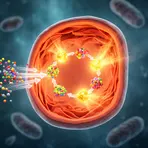
A series of reactions in the cell's mitochondria that change food molecules into energy

A series of chemical reactions in cells that make energy from food
Surface Forms
Morphology
Krebs + cycle
This is an eponymous technical term named after scientist Hans Krebs; knowing 'Krebs' as a name gives no information about biochemical processes. Although 'cycle' suggests a repeated sequence, that alone does not allow a B1 learner to infer the specific citric-acid series of cellular reactions, so the meaning is not derivable from the parts.
Etymology
The noun Krebs cycle is named after the scientist Krebs, who showed that a series of chemical steps in a cell goes round and comes back to the start like a 'cycle'. So, Krebs cycle means the repeating series of reactions inside cells that helps make energy.