
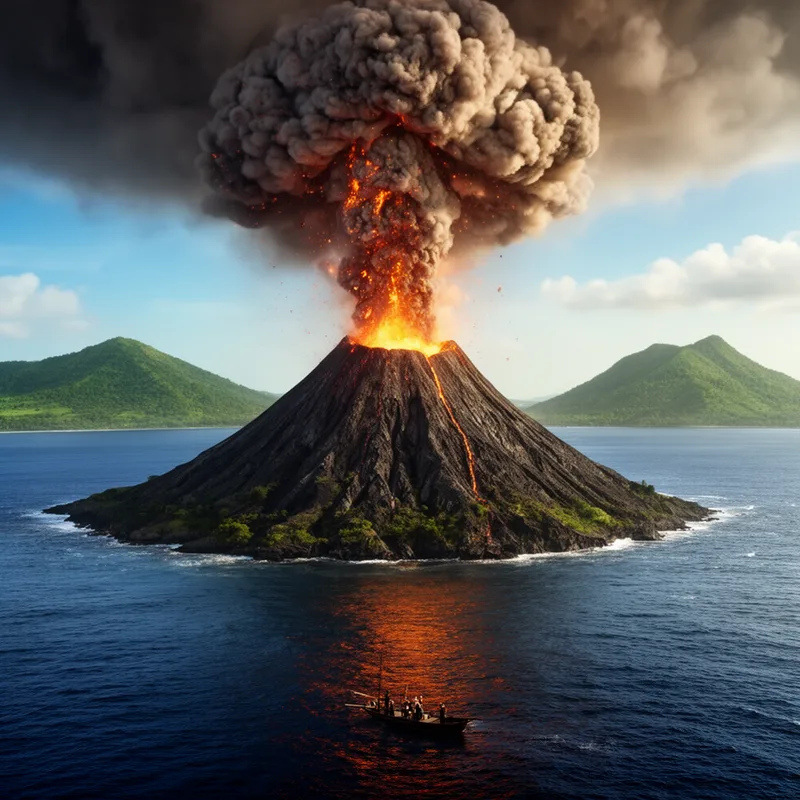
Krakatau
 1
7.3

- proper noun
- The same happened after the 1883 Krakatau eruption, both in the 1884 and 1885 eclipses.
- Krakatau volcanic eruption
- Anak Krakatau
- 1883 eruption of Krakatau
Examples
-
Some are not moving at all, but in general we know that glaciers have been retreating since around 1870. (Before that, they were growing due to the huge impact from Krakatau.)
Blog text (22) -
Nernst: "In the nineteenth century, when Mount Krakatau detonated, a lot of debris was blasted into the stratosphere."
Academic text (2011) -
Both Krakatau and Long Island lie more than 50 km from the coasts of their respective source communities.
Academic text (2005) -
Larger eruptions, such as the 1883 eruption of Krakatau in Indonesia, have caused even greater cooling that lasted longer.
Academic text (2009) -
However, the figs that have colonized Krakatau and Long Island are mostly common species with broad ecological tolerances (Thornton et al. 2001).
Academic text (2005) -
Indeed, the islands have seven species in common (37% of Krakatau's fig flora), despite being separated by more than 1,000 km and by a major biogeographic boundary (Wallace's line).
Academic text (2005) -
The eruption of Krakatau in 1883 is considered one of the most violent volcanic events in recorded history.
-
Many documentaries focus on the catastrophic eruption of Krakatau and its consequences for the surrounding areas.
-
Scientists still study the effects of the 1883 eruption of Krakatau to understand volcanic impacts on climate.
Synonyms
 3
7.5
A volcanic island in Indonesia between Java and Sumatra known for its huge 1883 eruption
Surface Forms
Etymology
Krakatau comes from the island's local Indonesian name, and one idea links it to an old Sanskrit word karkata meaning 'crab', perhaps because the island looked like a crab to sailors. A helpful way to remember it is to think of a small 'crab' island that made a huge, loud eruption in 1883, which is why Krakatau now names a famous volcanic island.