

Korea Strait
- noun
- The cargo ship passed through the Korea Strait on its way from South Korea to Japan.
Examples
-
The Korea Strait is known for its rich marine biodiversity and strategic importance.
-
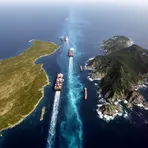
Many ships travel through the Korea Strait as they move between the Pacific and East Asian ports.
-
During World War II, naval battles took place in the Korea Strait.
-
The Korea Strait is crucial for shipping routes.
-
Many ships pass through the Korea Strait every day.
-
Fishermen often take advantage of the rich waters in the Korea Strait to catch a variety of fish.
-
The Korea Strait connects the East China Sea with the Sea of Japan, making it an important shipping route.
Synonyms


 1
3.7
1
3.7
A narrow body of water between Korea and Japan that connects the East China Sea and the Sea of Japan
Surface Forms
Morphology
The name is directly compositional: 'Korea' specifies the geographic region and 'strait' denotes a narrow sea channel, so the phrase refers to the channel near Korea. This toponymic naming pattern is cross-linguistically common and follows straightforward noun + noun composition, so a B1 learner who knows both words would readily infer the meaning.
Etymology
The place name Korea Strait is a simple geographic name: Korea is the nearby country and a strait is a 'narrow body of water' between two lands. So, the name literally tells you it is the narrow sea between South Korea and Japan, a route many ships use and a place often important in trade and history.