
Kon Tiki
 1
8.5

- noun
- /kɒn ˈtiːki/
Examples
-
Reidar Solsvik, Curator of the Kon-Tiki Museum in Oslo, has confirmed these points (Personal communication, 14 Aug. 2014).
Academic text (2014) -
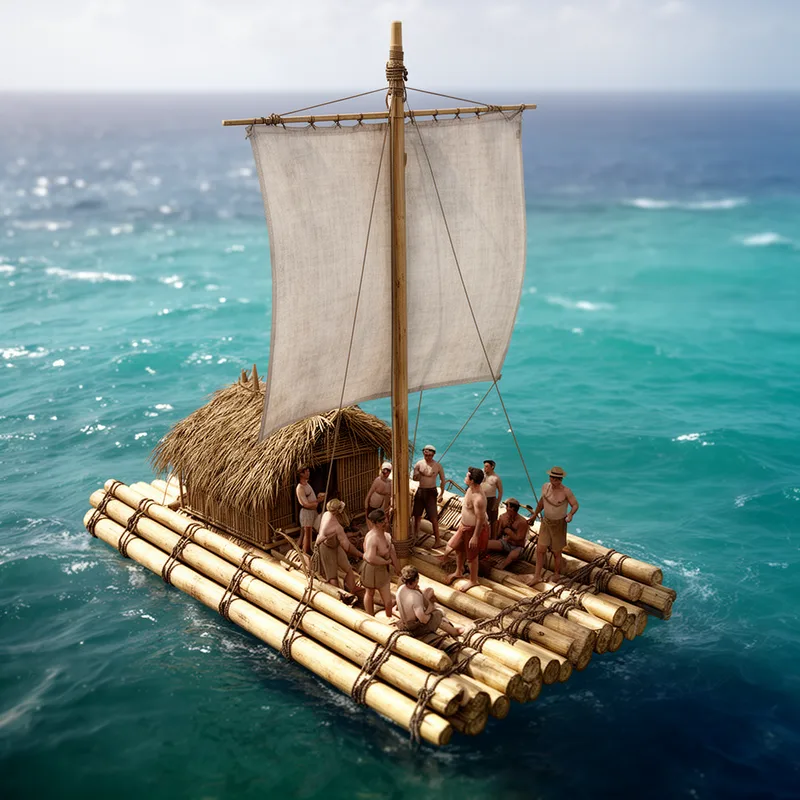
The Kon Tiki is a famous raft made of balsa wood that was used in Thor Heyerdahl's expedition across the Pacific Ocean in 1947.
-
During the museum tour, we learned about the Kon Tiki, the raft that made history by demonstrating the possibility of prehistoric oceanic travel.
-
The replica of the Kon Tiki was displayed prominently at the exhibition, showcasing its unique construction and significance in maritime exploration.
Synonyms
 112
1.5
A flat platform of logs or planks fastened together to float on water


 1
5.4
A light raft made from balsa wood used for travel on water
Surface Forms
Morphology
Kon + tiki
This is a proper name for Thor Heyerdahl's raft/expedition and is not compositionally built from its parts: 'Kon' is not a productive English lexical item and 'tiki' refers to a Polynesian carved figure, not to a raft. A B1 learner who knows these constituent meanings would not be able to infer the specific sense 'a balsa raft/Heyerdahl's expedition', so the expression is non-compositional and unpredictable.
Etymology
Kon Tiki is the name Thor Heyerdahl gave to a simple 'raft' made of floating 'balsa' logs when he sailed across the Pacific in 1947 to show that people long ago could cross the ocean. That's why the name Kon Tiki now means a light 'balsa' raft like the one from his famous journey.