
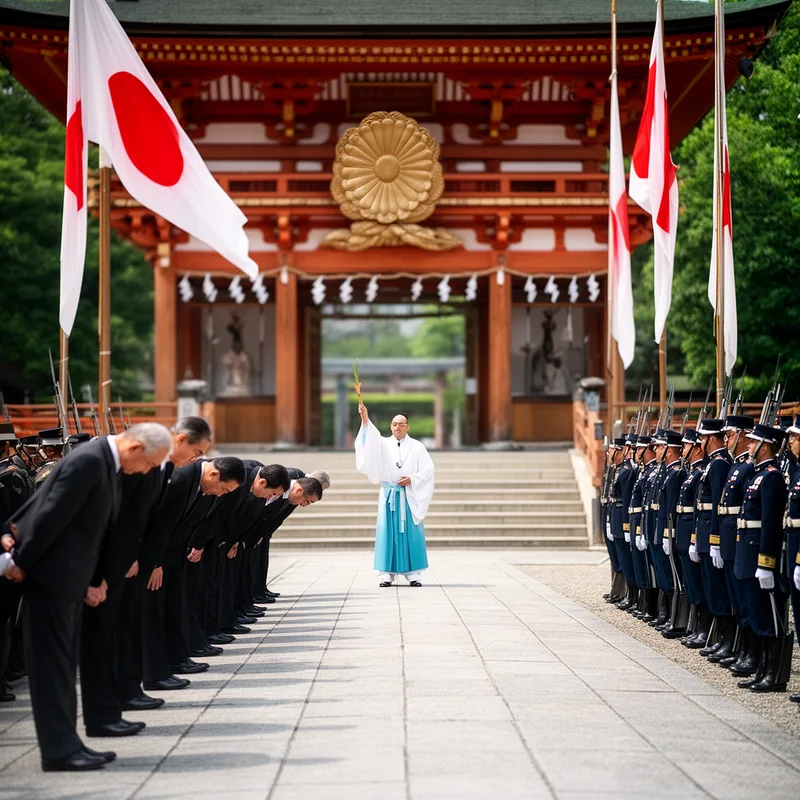
Kokka Shinto
- noun
- During the Meiji era, Kokka Shinto played a central role in shaping Japan's national identity.
Examples
-
After World War II, the Allied Occupation abolished Kokka Shinto as a state-supported religion.
-
Textbooks often discuss the influence of Kokka Shinto on Japanese society and government policies.
-
Is Kokka Shinto still practiced in Japan today?
-
How did Kokka Shinto influence Japanese culture?
-
During the Meiji era, Kokka Shinto played a central role in shaping Japan's national identity.
-
After World War II, the Allied Occupation abolished Kokka Shinto as a state-supported religion.
-
Textbooks often discuss the influence of Kokka Shinto on Japanese society and government policies.
Synonyms
A form of Shinto that was Japan's state religion from Meiji to World War II
Surface Forms
Morphology
The compound is compositionally built from 'Kokka' (state/national) + 'Shinto' (the indigenous faith), so its meaning as the state-promoted form of Shinto is directly derivable from the parts. This is a straightforward, non-idiomatic naming pattern (equivalent to 'state Shinto'), making it immediately understandable to learners who know the constituent meanings.
Etymology
Kokka Shinto comes from the Japanese words kokka meaning 'state' and Shinto meaning the native religion. It describes when the government made Shinto an official 'state religion' in the Meiji period to support the emperor and unite the country, so the term now means the form of Shinto that was backed by the state.

