
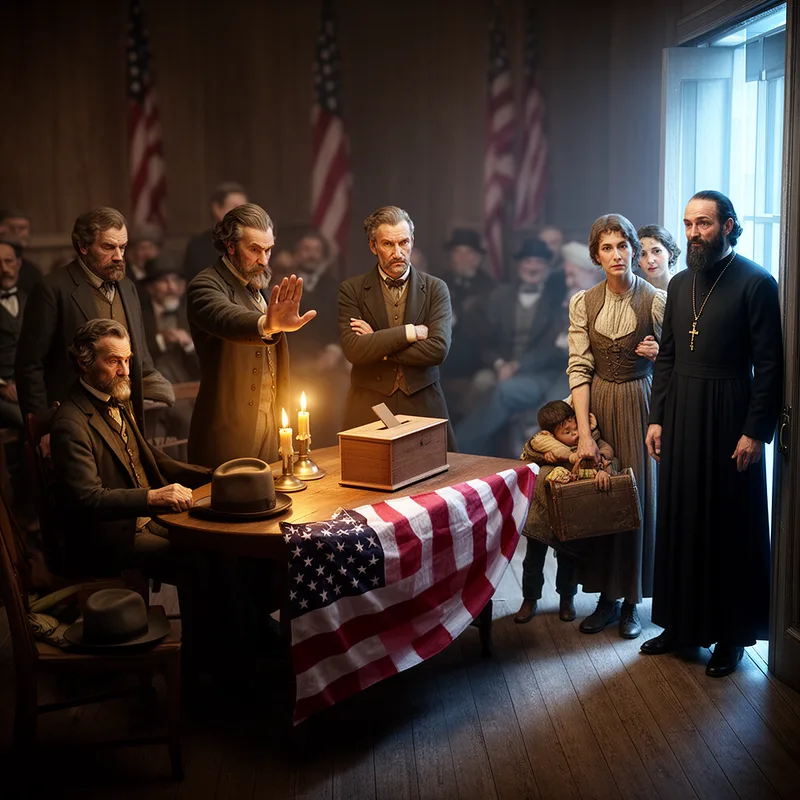
Know-Nothing Party
- noun
- /noʊ ˈnʌθɪŋ ˈpɑrti/
- Offensive
- The book also painted immigrants from Asia and Southern and Eastern Europe in a rather unfavorable light, despite condemning nativist movements such as the Know-Nothing Party.
Examples
-
The Know-Nothing Party was known for promoting anti-immigrant sentiment in the United States during the mid-19th century.
-
It is entirely appropriate that the Know-Nothing Party had its origin in the Secret Society of the Star-Spangled Banner.
Academic text (1990) -
The Know-Nothing Party did not oppose sabbatarian laws.
Academic text (1990) -
The Know-Nothing Party, having failed to restrict naturalization, resorted instead to political purges and deportations.
Academic text (1990) -
Moreover, with the anti-immigrant Know-Nothing party's landslide of 1854, the legislature required the daily reading of the Protestant Bible in every public school.
Academic text (2002) -
Much of the focus for both groups of historians centers on the realignment of the 1850s, which saw the death of the Whig Party, the rise of the nativist Know Nothing Party, the creation of the Republican Party, and eventually, the sectional split within the Democratic Party that preceded the outbreak of the Civil War.
Academic text (1994) -
In the 1850s, the Know-Nothing Party gained attention for its strong opposition to immigration and Catholic influence.
-
Fillmore was the nominee of the Know-Nothing Party during the 1856 presidential election, advocating for nativist policies.
Synonyms
A US political group in the 1850s that wanted to limit immigrant and Catholic influence
Surface Forms
Morphology
Know-Nothing + party
While 'party' is transparent as a political group, the modifier 'Know-Nothing' is an idiomatic historical label whose specific meaning (a mid-19th-century nativist, anti-immigrant American movement) cannot be derived from knowing 'know' and 'nothing'. A B1 learner might infer a literal sense like 'people who know nothing' but would not predict the movement's political stance or historical reference, so the overall expression is opaque.
Etymology
Know-Nothing Party comes from mid-1800s American politics. Members were secret and, when asked about their group, often said 'I know nothing', so people called them the Know-Nothing Party, a name that came to mean a political group that was against immigrants and Catholics.

