
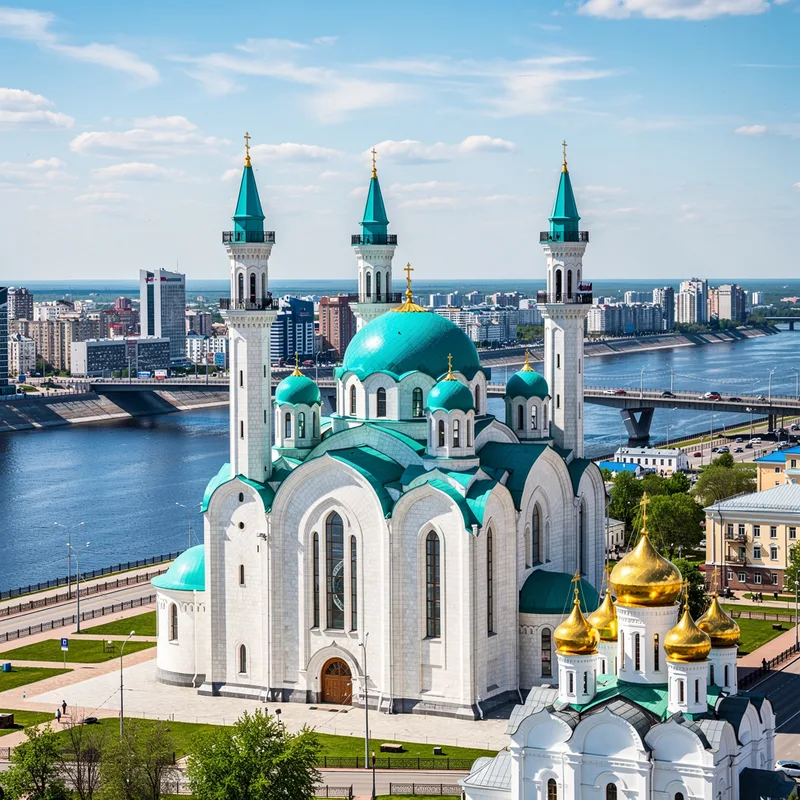
Kazan
 3
7.4

- proper noun
- I met the Tatar President in his offices in the Kazan Kremlin.
- Khanate of Kazan
- monastery in Kazan
- archbishopric of Kazan
Loading YouTube…
Watch on YouTubeLike the Bulgur Tatar state which which which then becomes later the Kazan Hanat, which today is Tatarstan in Russia, right?
- Like the Bulgur Tatar state which which which then becomes later the Kazan Hanat, which today is Tatarstan in Russia, right?
Examples
-
The local cults flourished; pilgrims traveled to Kazan specifically to pray at its holy sites.
Academic text (2007) -
For the Russian Orthodox, therefore, Kazan had become a holy city.
Academic text (2007) -
I believe the capital is Kazan.
-
The Russian Orthodox Church's position in the former Khanate of Kazan was both powerful and complex.
Academic text (2007) -
Indeed, the region's first convent was established inside Kazan's walls, more than twenty years after the city's first two monasteries.
Academic text (2007) -
Similarly, Ivan IV ordered the foundation of Kazan's Bogoroditskii Devichii Convent in 1579 to house Kazan's Mother of God Icon.
Academic text (2007) -
Ivan conquered Tartar lands in Kazan and Astrakhan, but was defeated in the Livonian War by Sweden and the Polish Lithuanian Commonwealth.
-
Kazan is known for its rich history and beautiful architecture in Kazan.
-
Many tourists visit Kazan to explore the Kremlin and enjoy its local cuisine.
-
The annual international Kazan Festival attracts artists from around the world.
Surface Forms
Etymology
Kazan comes from a Tatar word kazan that means 'cauldron' or 'to boil', like the English word 'cauldron'. One popular story says the city was named for a large cooking pot or because the river and hills make a bowl shape, so a simple way to remember Kazan is to picture a big pot or a bowl-like place.