
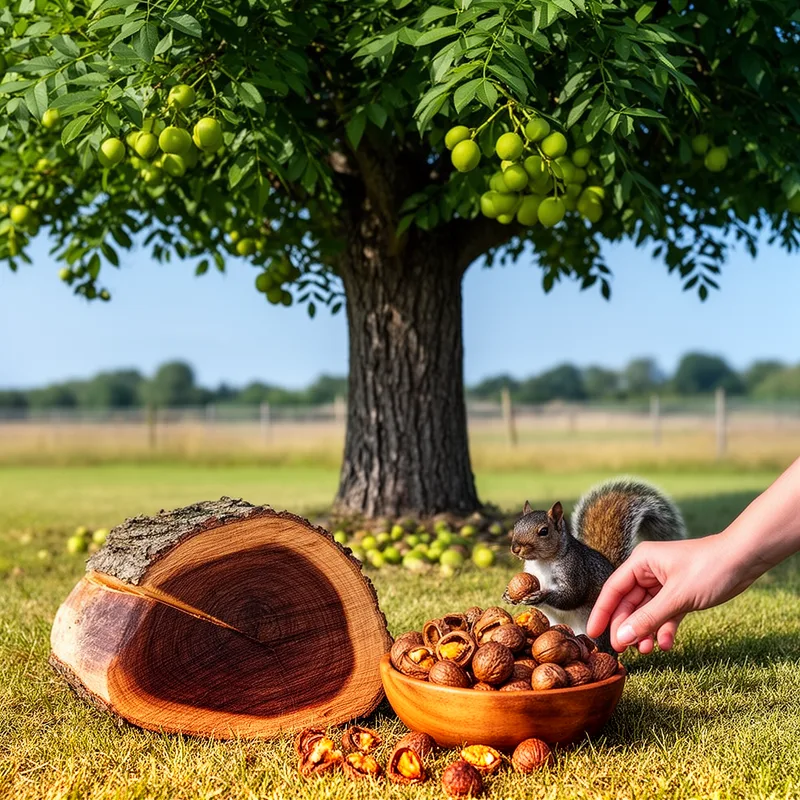
Juglans nigra
- noun
- /ˈdʒʌɡləns ˈnɪɡrə/
- Specialized
- The Juglans nigra tree can grow up to 100 feet tall.
Examples
-
Farmers often plant Juglans nigra as a valuable timber resource and for its edible nuts.
-
Many antique furniture pieces are crafted from Juglans nigra because of its beautiful, durable wood.
-
The nuts of Juglans nigra are highly prized by both wildlife and humans.
-
Many artisans prefer Juglans nigra for its beautiful dark wood.
-
The black walnut (Juglans nigra) is prized for its rich flavor in baking and cooking.
-
Many furniture makers choose the durable wood of the black walnut (Juglans nigra) for high-quality pieces.
-
After clearing the area, we planted a young black walnut tree (Juglans nigra) in our yard.
Synonyms

 5
1.0
5
1.0

A large tree that makes hard nuts and has long leaves made of many small parts
 2
2.7
2
2.7
A tree that makes nuts you can eat and strong wood for furniture
 1
4.3
1
4.3
A large tree from North America with dark hard wood and nuts you can eat
A North American tree with hard dark wood and edible nuts
Surface Forms
Morphology
Juglans + nigra
This is a Latin binomial name: 'Juglans' identifies the walnut genus, which signals the general referent (a walnut tree), but the second element 'nigra' is a Latin epithet (not an everyday English word) whose meaning ('black') is not given in the input. A B1 learner who knows botanical naming conventions or the Latin/ Romance cognate 'nigra/negra' could infer ‘black walnut’, but without that background the species epithet is not transparently interpretable, so the phrase is only partially transparent.
Etymology
Juglans nigra comes from old Latin words: Juglans once meant 'Jupiter's walnut' and nigra means 'black'. This name points to the tree's dark wood and its edible nuts, so today it simply means the 'black walnut' tree.