
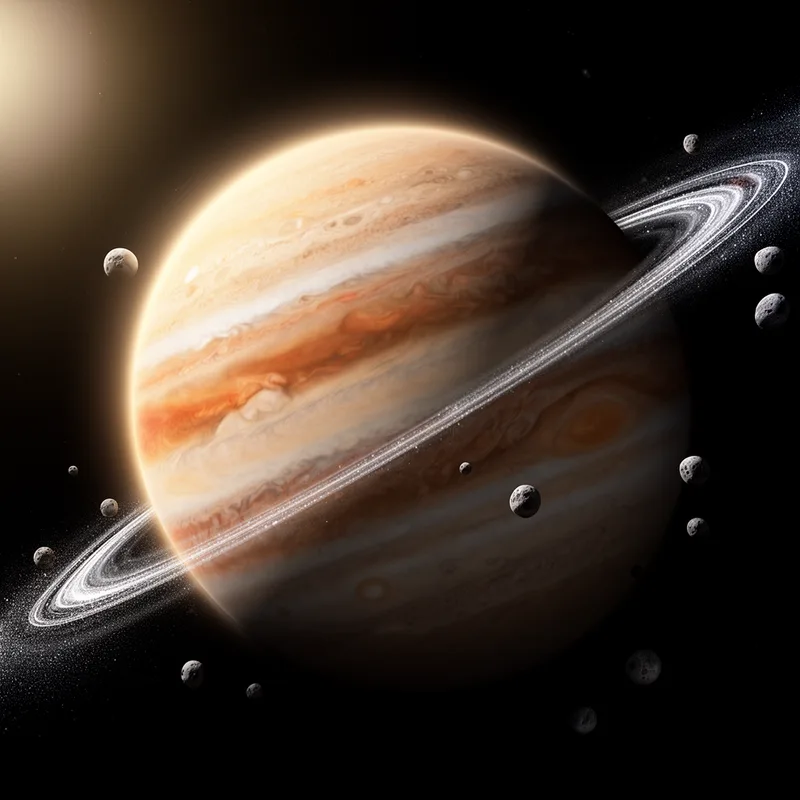
Jovian planet


 1
6.8
1
6.8
- noun
- /ˈdʒoʊviən ˈplænɪt/
- Specialized
- Astronomers study the atmospheres of the Jovian planets to understand their complex weather patterns.
Examples
-
Jupiter, Saturn, Uranus, and Neptune are classified as Jovian planets due to their gaseous composition.
-
Whereas the Jovian planets, that is the planets that are like Jupiter in some way, are much larger, much lower density.
-
And out beyond the asteroids you've got the outer planets, sometimes called the Jovian planets because Jupiter is the prime example of these things.
-
Click my name here for stellar expert James Kaler's updated Fomalhaut page noting the newly imaged Jovian planet at a trans-Neptunean distance.
Blog text (1) -
The four Jovian planets are significantly larger than Earth and consist mainly of gases.
Synonyms
 5
4.2
5
4.2
A large planet that orbits the Sun beyond the asteroid belt, like Jupiter
How Big

Surface Forms
Morphology
The adjective 'Jovian' means 'of or relating to Jupiter', so combining it with 'planet' yields a planet like Jupiter (i.e., a Jupiter-like or gas‑giant planet); this meaning is compositionally derivable from the constituents. The adjective+noun pattern is a regular, cross-linguistic composition, so learners who know both words can predict the MWE meaning.
Etymology
Jovian planet comes from the name of the Roman god Jupiter; 'Jovian' means 'of Jupiter'. These planets are big and made mostly of gas, so the name came to mean 'large gas planets'.