
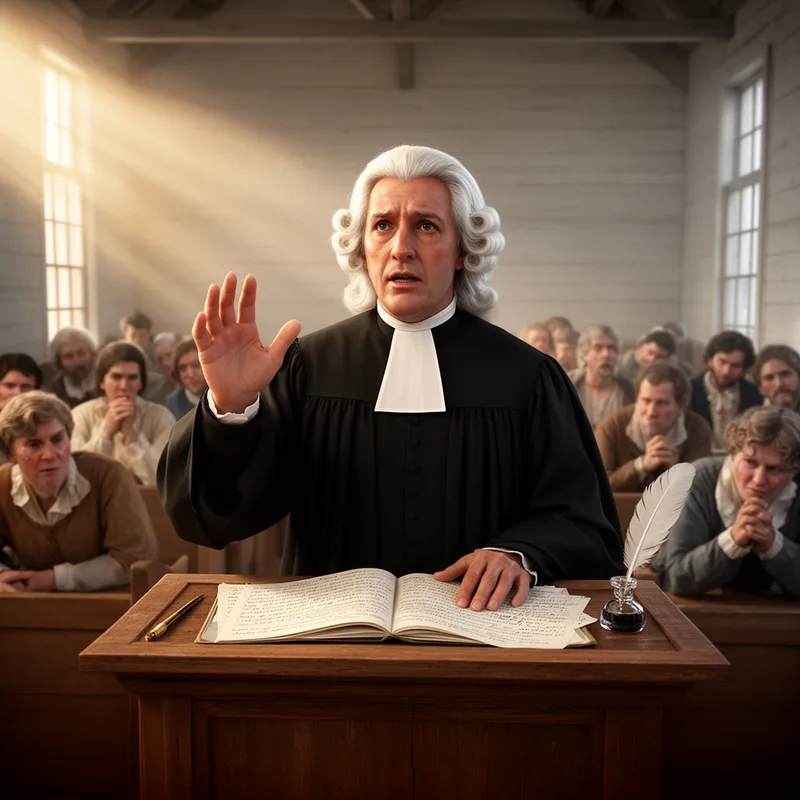
Jonathan Edwards
 1
9.1

- proper noun
- /ˈdʒɒnəθən ˈɛdwərdz/
- In the summer of 1756, Jonathan Edwards preached a simple yet extraordinary sermon to his Indian congregation at Stockbridge, Massachusetts, where he had served as a missionary for five years.
Examples
-
Viewed within its social context, Jonathan Edwards' Original Sin emerges as an oddly egalitarian text.
Academic text (2003) -
As Gerald McDermott has explained, Jonathan Edwards gave a great deal of attention to non-Christian religions, including Islam.
Academic text (2003) -
Jonathan Edwards believed the world would be a better place if God's saints were in charge.
Academic text (2003) -
Jonathan Edwards' Original Sin was an innovative defense of a traditional Calvinist doctrine.
Academic text (2003) -
He seems to have influenced a number of American clerics, including Jonathan Edwards.
Academic text (2003) -
Jonathan Edwards' son-in-law Aaron Burr also developed a speculative eschatology with a special place for Islam.
Academic text (2003) -
JONATHAN EDWARDS, PASTOR TO THE STOCKBRIDGE INDIANS
Academic text (2003) -
In the summer of 1756, Jonathan Edwards preached a simple yet extraordinary sermon to his Indian congregation at Stockbridge, Massachusetts.
-
Jonathan Edwards' Original Sin was an innovative defense of a traditional Calvinist doctrine.
-
Jonathan Edwards believed the world would be a better place if God's saints were in charge.
Surface Forms
Morphology
Jonathan + Edwards
This is a proper name referring to a specific historical individual; the literal constituent names 'Jonathan' and 'Edwards' do not convey his role or historical significance. Because the meaning is referential and arbitrary rather than compositional, a B1 learner who only knows the name parts would not infer 'American theologian and preacher' from the words alone.
Etymology
Jonathan Edwards was an American preacher in the 1700s who gave powerful sermons, such as the famous 'Sinners in the Hands of an Angry God', that made people feel deep religious emotion. He helped start a big wave of church revival called the 'First Great Awakening', so today he is remembered as a leading religious leader of that time.