

John Dory
 1
7.9
1
7.9

- noun
- /dʒɒn ˈdɔːri/
- UK
- They served John Dory at the seafood restaurant, and it was the highlight of the meal.
Examples
-
For dinner, we had John Dory, which was tender and flavorful.
-
The chef prepared a delicious John Dory fillet with lemon butter sauce.
-
In another example, the John Dory has at least four listings: once with just the family name Zeidae, under the A's as "American John Dory," with the Latin name Zenopsis ocellata, and also with the Latin name Zeus japonicus.
Academic text (1990) -
In another example, the John Dory has at least four listings: once with just the family name Zeidae, under the A's as "American John Dory," with the Latin name Zenopsis ocellata, and also with the Latin name Zeus japonicus.
Academic text (1990)
Synonyms
 2
9.0
2
9.0
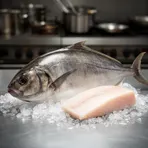
A sea fish with a deep, round body and pale flesh prized by cooks
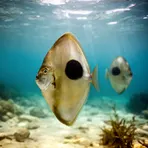
A fish with a deep, flat body and a dark spot on each side that lives near European coasts
Surface Forms
Morphology
John + dory
Because one constituent, 'dory', can be recognized as a type of fish, a B1 learner who knows both words will likely infer that 'John Dory' refers to a kind of fish; however the element 'John' is an arbitrary proper name that does not contribute predictable semantic features, and the specific species/attributes (Zeus faber, European fish with firm white flesh) are not derivable from the parts. The name formation is partially compositional (class = dory/fish) but otherwise arbitrary and language-specific, so the expression is only partly transparent.
Etymology
John Dory may come from the old French phrase 'jaune doré', meaning 'golden yellow', because the fish has a pale, shiny body and a dark round spot that fishermen noticed. So the name stuck and today John Dory refers to this valued food fish.