
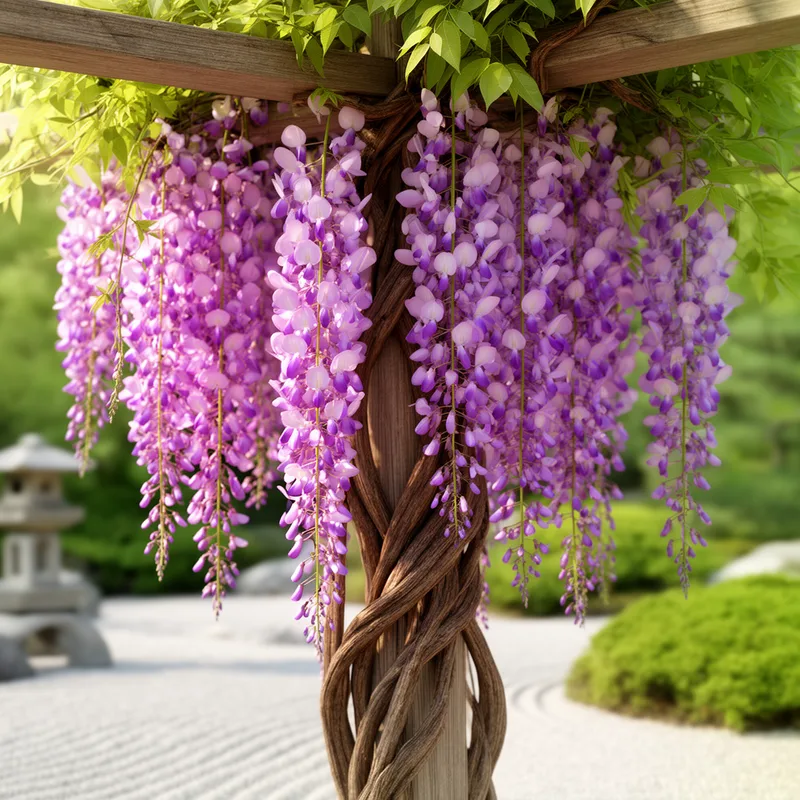
Japanese wistaria
- noun
- /ˌdʒæpəˈniːz wɪˈsteəriə/
- Archaic
- The Japanese wistaria bloomed beautifully along the garden trellis this spring.
Examples
-
Many traditional Japanese gardens feature Japanese wistaria for their vibrant, cascading flowers.
-
Botanists admire the Japanese wistaria for its fragrant blossoms and vigorous growth.
-
The garden is filled with beautiful Japanese wistaria.
-
Have you seen the Japanese wistaria in bloom?
-
Many traditional Japanese gardens feature Japanese wistaria for their vibrant, cascading flowers.
-
Botanists admire the Japanese wistaria for its fragrant blossoms and vigorous growth.
-
The Japanese wistaria bloomed beautifully along the garden trellis this spring.
Synonyms

 4
7.4
4
7.4

A climbing plant with hanging purple or white flowers grown for decoration
A climbing plant with long hanging clusters of pink and purple flowers often grown on walls and trellises
Surface Forms
Morphology
Japanese + wistaria
The phrase is a straightforward adjective-of-origin ('Japanese') + noun ('wistaria') construction, so its meaning — a variety of wistaria from Japan or a wistaria associated with Japan — is directly derivable from the parts. Adjective + noun origin patterns are cross-linguistically common and follow standard English modification rules, making this immediately comprehensible to a B1 learner who knows the constituents.
Etymology
Japanese wistaria comes from an old spelling of the plant name wisteria, which people once linked to the American doctor Caspar Wistar, so gardeners sometimes used 'wistaria' for this climbing plant. Picture long purple flowers hanging like curtains in a Japanese garden — that image explains why the name means the showy, climbing plant with hanging flower clusters.