
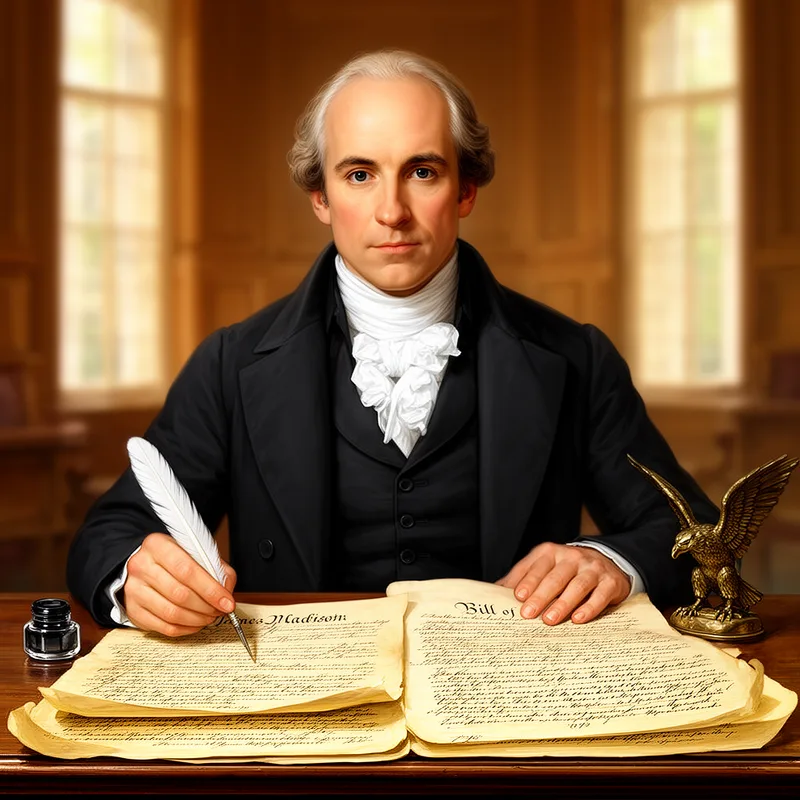
James Madison
 14
4.1

- proper noun
- /ˈdʒeɪmz ˈmædɪsən/
- The swirling and sometimes vicious debate over nominations and judges is exactly what was predicted 200 years ago by James Madison and Alexander Hamilton in the Federalist Papers, says Edward N. Madeira, chair of the ABA's Commission on Separation of Powers and Judicial Independence.
- James Madison of the Federalist
- James Madison wrote
Examples
-
Just how foreign the regime of equal command is to our constitutional system becomes apparent when placed alongside the design of James Madison, who shared the reformer's concern with "undue influence," or what he called "factions."
Academic text (1998) -
Jay, a coauthor with Hamilton and James Madison of the Federalist Papers, would not agree to such partisan constitutional manipulation.
Academic text (1997) -
After the ratification struggle in Virginia, Patrick Henry made it his business to end the public career of James Madison.
Academic text (1990) -
Early into the proceedings, Edmund Randolph, working with James Madison, offered his Virginia Plan.
Academic text (1990) -
James Madison explained in The Federalist that "the danger of oppression" in a democracy came from "the majority of the community."
Academic text (1997) -
The only early president to exercise the veto power with any frequency was James Madison, who vetoed seven bills, all on constitutional grounds.
Academic text (1997) -
Court foe Thomas Jefferson had just been elected president, and at his urging, Secretary of State James Madison openly challenged the judiciary's power to subject the executive branch to court orders.
Academic text (1997) -
It would have to behave with energy to confront what James Madison predicted, in another Federalist essay, would be an omnivorous Congress.
Academic text (1990) -
In making the case for separating church and state, James Madison argued that in a diverse land, individuals could never consent to any universal set of religious propositions and, even if a majority did concur, he feared that state-imposed adherence would violate natural rights.
Academic text (1997) -
President James Madison played a crucial role in drafting the U.S. Constitution.
Synonyms
 2
5.8
American leader who helped write the Constitution and Bill of Rights and was the fourth President of the United States
Surface Forms
Morphology
James + Madison
This is a proper name referring to a specific historical person, so its reference is encyclopedic rather than compositional. Knowing the individual name tokens 'James' and 'Madison' does not allow a B1 learner to infer biographical facts (e.g. fourth U.S. president, contributor to the Constitution), so the meaning is not derivable from the constituents.
Etymology
James Madison was a key American leader who helped write the United States Constitution. He kept many notes and wrote important papers at the meeting where the Constitution was made and pushed for the Bill of Rights, so people call him the 'Father of the Constitution' today.