

Italian woodbine
- noun
- UK
- Gardeners often train Italian woodbine to climb trellises for its attractive flowers and foliage.
Examples
-
The Italian woodbine flourished along the old stone wall, filling the air with its sweet scent.
-
The Italian woodbine blooms beautifully in spring.
-
Bees are drawn to the nectar of the Italian woodbine during the early summer months.
-
I planted an Italian woodbine near the fence.
-
Bees are drawn to the nectar of the Italian woodbine during the early summer months.
-
Gardeners often train Italian woodbine to climb trellises for its attractive flowers and foliage.
-
The Italian woodbine flourished along the old stone wall, filling the air with its sweet scent.
Synonyms

 11
4.3
11
4.3

A climbing plant that has sweet-smelling, tube-shaped flowers and is grown to decorate gardens
 1
9.9
1
9.9
A climbing plant with sweet-smelling red and pale yellow flowers
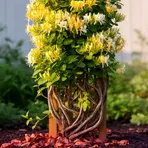
A climbing shrub with sweet-smelling yellow and white flowers that loses its leaves in winter

A climbing shrub with sweet-smelling white and yellow flowers that attract bees and butterflies
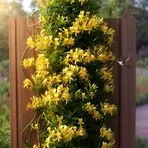
A climbing bush with sweet-smelling yellow flowers often grown in gardens

A group of climbing shrubs in the honeysuckle family with sweet, tube-shaped flowers
Surface Forms
Morphology
The phrase is a straightforward adjective + noun composition: 'Italian' specifies origin/association and 'woodbine' names a twining honeysuckle, so the meaning (a woodbine associated with Italy or an Italian variety) is directly inferable. This compositional, botanical naming pattern is common cross-linguistically, so a B1 learner who knows both constituents would understand the MWE.
Etymology
Italian woodbine may come from the old idea of a vine that 'binds' itself to wood: woodbine comes from wood + bind, meaning a plant that wraps around fences and trees. The word 'Italian' shows a link to Italy, so the name helps remember it is a fragrant 'climbing shrub' often used to cover walls and trellises.