
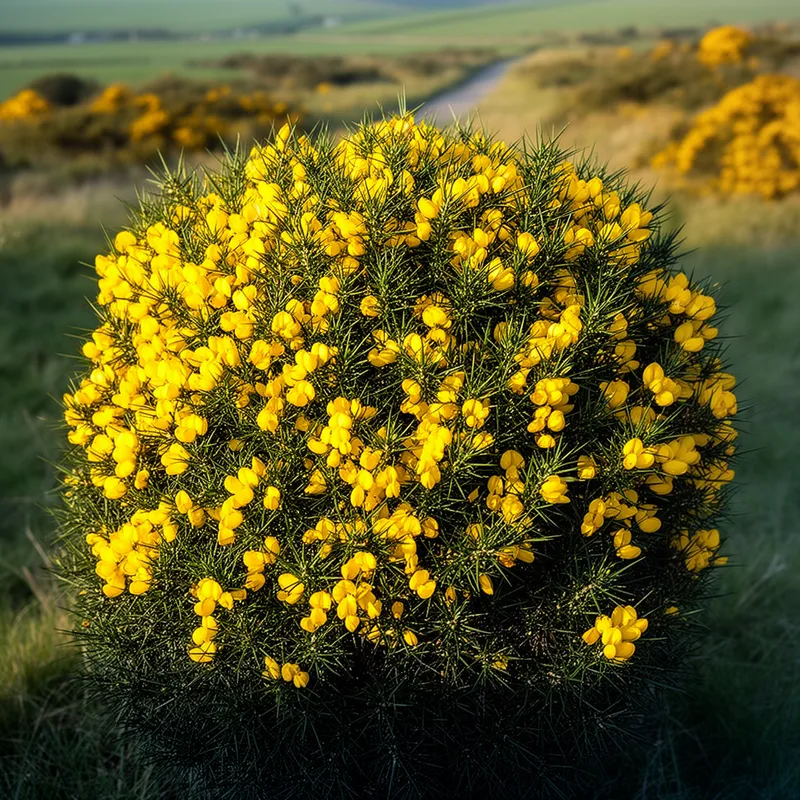
Irish gorse
- noun
- UK
- Gardeners often plant Irish gorse as a natural barrier due to its dense, spiny branches.
Examples
-
The hills were covered with Irish gorse, creating a brilliant yellow landscape in the spring.
-
You can smell the fragrance of Irish gorse as you walk through the countryside.
-
The Irish gorse blooms beautifully in spring.
-
We saw Irish gorse covering the hills during our hike.
-
The hills were covered with Irish gorse, creating a brilliant yellow landscape in the spring.
-
Gardeners often plant Irish gorse as a natural barrier due to its dense, spiny branches.
-
You can smell the fragrance of Irish gorse as you walk through the countryside.
Synonyms

 1
9.1
1
9.1

A bush with sharp thorns and bright yellow flowers that smell nice

 1
9.9
1
9.9
A spiny evergreen bush with bright yellow flowers that grows on hills
 1
9.9
1
9.9
A bush with sharp thorns and bright yellow flowers

A very spiny evergreen bush with bright yellow flowers
Surface Forms
Morphology
The phrase is a straightforward adjective + noun composition: 'Irish' (pertaining to Ireland) modifies 'gorse' (an evergreen shrub), so a learner who knows both words can infer it refers to a gorse associated with Ireland. There is no idiomatic or metaphorical shift, and this adjectival naming pattern is cross-linguistically common, making the meaning immediately recoverable.
Etymology
Irish gorse may come from people naming the bright, spiny shrub gorse that grows a lot in Ireland, with Irish added to show where it is common. That's why the name now refers to the dense, spiny evergreen shrub with fragrant golden-yellow flowers.