
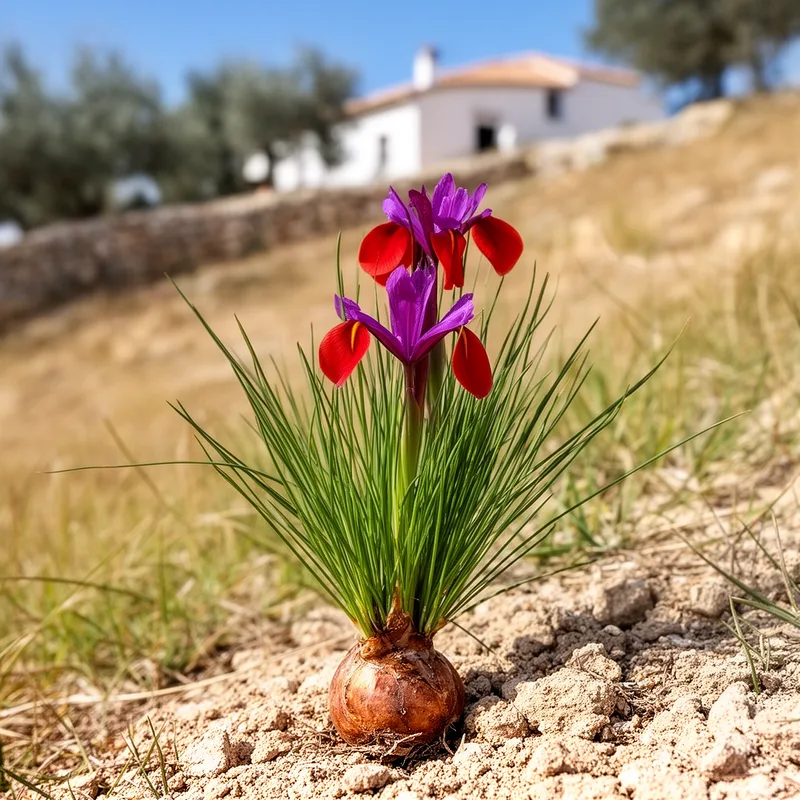
Iris filifolia
- noun
- Specialized
- Many gardeners love the Iris filifolia for its vibrant red-violet flowers.
Examples
-
Botanists studied the natural habitat of Iris filifolia during their trip to Spain.
-
The gardener planted several Iris filifolia bulbs to add color to the spring borders.
-
A rare variety of Iris filifolia bloomed earlier than expected this year.
-
The Iris filifolia blooms beautifully in the spring.
-
Many gardeners love the Iris filifolia for its vibrant colors.
-
The gardener planted several Iris filifolia bulbs to add color to the spring borders.
-
A rare variety of Iris filifolia bloomed earlier than expected this year.
Surface Forms
Morphology
iris + filifolia
This is a Latin binomial: 'Iris' clearly identifies the genus (a type of flower), so a learner who knows 'iris' can infer it names a kind of iris, but 'filifolia' is a Latin epithet not found in the dictionary and its literal sense ('thread‑leaved') is unlikely to be known by a B1 learner. The overall category (a species of iris) is therefore predictable from the parts, while the specific descriptive meaning is not transparently derivable.
Etymology
Iris filifolia comes from two old words: Iris, the Greek word for 'rainbow' and for the flower, and filifolia, the Latin phrase for 'thread-like leaves'. So the name gives a clear picture of a small iris with thin, thread-like leaves and bright red-violet flowers, which is why it fits this Spanish species.

