

Indochinese


 1
6.7
1
6.7
- adjective
- /ˌɪndoʊˈtʃiːnz/
- Keiko Hirata notes the significance of the Indochinese refugee crisis in expanding NGOs in Japan.
- Indochinese refugees
- Indochinese peninsula
Examples
-
Despite these changes, there is little semblance of democracy in any of the three Indochinese countries.
Academic text (1991) -
Organization names indicated their focus on providing services to Indochinese refugees, not policy or advocacy.
Academic text (2016) -
Changes in non-Communist Southeast Asia have been of a different sort but were no less important than those in the Indochinese states.
Academic text (1991) -
Three Indochinese tigers now reside in North American zoos, all in Cincinnati.
Academic text (1992) -
Although the impact of the Indochinese refugee crisis was significant insofar as it spurred the establishment of about twenty NGOs, the broader political impact was limited.
Academic text (2016) -
Thailand's role was central to the Indochinese conflict because it was near Vietnam and also bordered on Laos and Cambodia, where communist insurgency was a potent domestic political force.
Academic text (2001) -
Despite the lack of relations, limited contact between officials from both countries on a humanitarian level—seen in talks on POW/MIAs, Amerasian children, and Indochinese refugees—has been evident.
Academic text (1992) -
The Indochinese culture is known for its rich history and diverse traditions.
-
Many Indochinese languages share similarities with each other due to their geographic proximity.
-
The documentary explores the impact of the Indochinese conflict on local communities.
Compounds
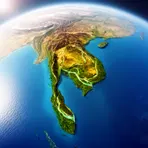
A large peninsula in Southeast Asia that includes Myanmar, Thailand, Vietnam, Laos, Cambodia and part of Malaysia
Surface Forms
Morphology
Etymology
Indochinese comes from the parts Indo- ('India') and Chinese ('China'), pointing to the lands between those two countries often called Indochina. So when something is Indochinese, it means it relates to the people, languages, or culture of that region.