
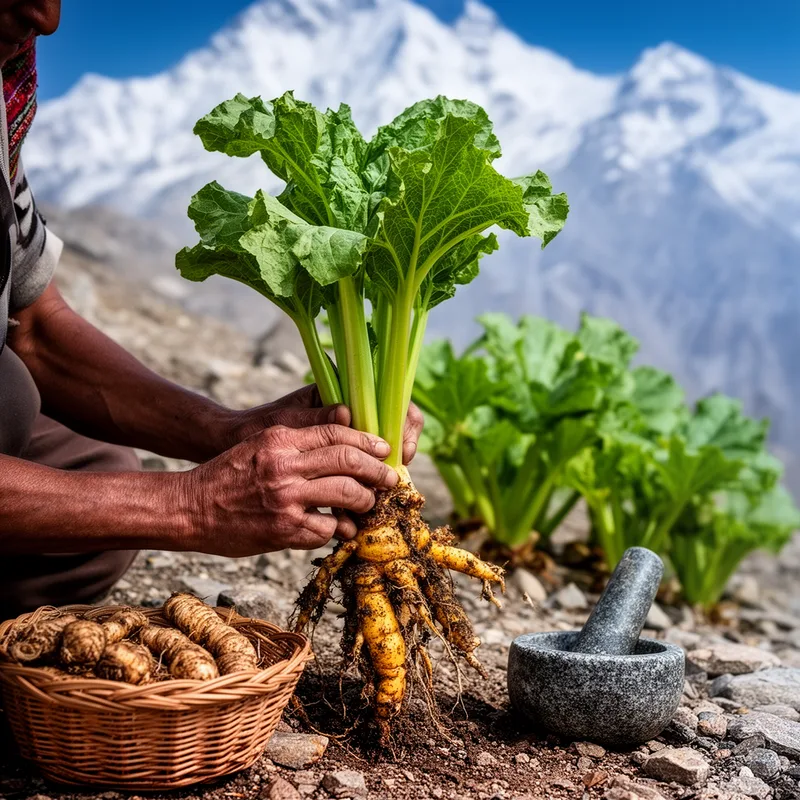
Indian rhubarb
- noun
- /ˈɪndiən ˈruːbɑːrb/
- Indian
- The roots of Indian rhubarb are used in traditional medicine across the Himalayas.
Examples
-
She purchased dried Indian rhubarb at the herbal market for its purported health benefits.
-
Many herbalists use Indian rhubarb for its medicinal properties.
-
Botanists studied the growth patterns of Indian rhubarb in its native habitat.
-
The Indian rhubarb plant thrives in the Himalayas.
-
Herbalists often recommend Indian rhubarb for its medicinal uses in traditional remedies.
-
In the Himalayas, the roots of Indian rhubarb are harvested for their health benefits.
-
You can find Indian rhubarb at specialty herbal shops, where it's known for its unique properties.
Synonyms

A mountain rhubarb plant from the Himalayas with large leaves and roots used as medicine

A plant from the Himalayas whose roots are used in traditional medicine

A large mountain plant with thick roots used in traditional medicine and for making yellow dye

A rhubarb plant from Asia that is used in traditional medicine to help people with constipation

A herb from the Himalayas with red veins in its leaves used in pies
Surface Forms
Morphology
The meaning is compositionally built from 'Indian' (denoting origin or relation to India) + 'rhubarb' (a plant), so a learner will infer it refers to a rhubarb species/variety associated with India or the Himalayas. This adjective+noun origin/type pattern is cross-linguistically common, making the phrase immediately understandable to B1 learners who know the constituents.
Etymology
Indian rhubarb was called that by early traders and healers because its thick roots and sour taste reminded them of common rhubarb, and it came from India or the Himalayan area. So the name points to a rhubarb-like plant from Asia that was 'used in traditional medicine'.

