
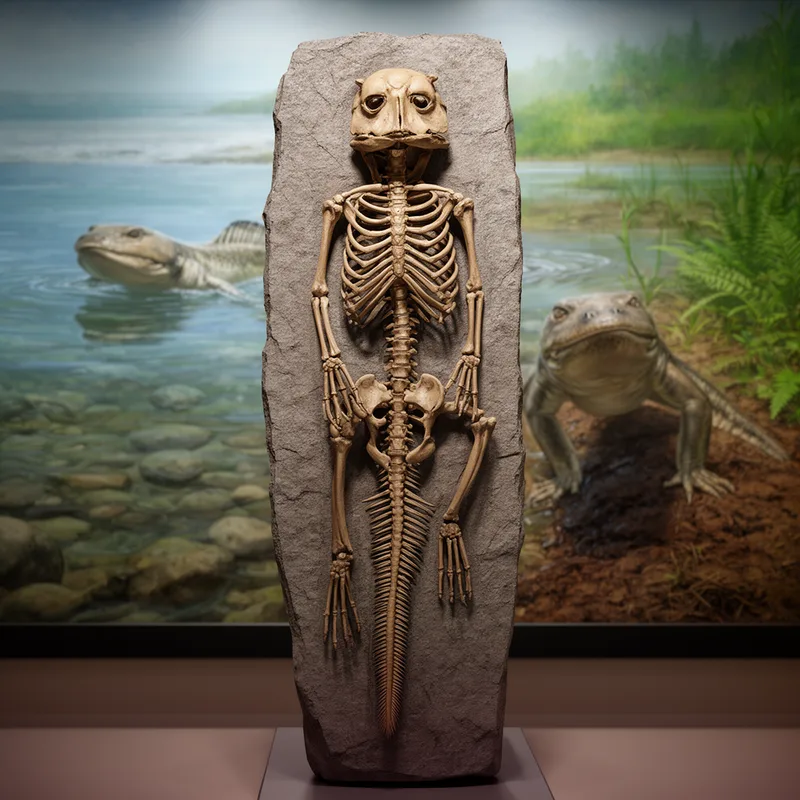
Ichthyostega


 1
9.9
- proper noun
- /ɪkˌθiːoʊˈstɛɡə/
- Specialized
- And in the same general location, though in slightly different sediment beds, we found a few remains of Ichthyostega.
Examples
-
The tail, though, was finned like that of a fish and marked Ichthyostega as primitive.
Academic text (2006) -
The specimens from our 1987 expedition gave us the first clue that something was wrong with the earlier image of Ichthyostega.
Academic text (2006) -
Two of the first such creatures were called Ichthyostega and Acanthostega.
Academic text (2003) -
But Ichthyostega could have readily flexed its body up and down.
Academic text (2006) -
For example, it might have enabled Ichthyostega to listen for aquatic prey.
Academic text (2006) -
Acanthostega was mostly aquatic; Ichthyostega was partly terrestrial.
Academic text (2006) -
For example, Ichthyostega skulls indicated how breathing organs and ear regions derived from the gill areas of fish.
Academic text (2006) -
When I became a paleontologist about twenty-five years ago, the evolution of four-legged animals from their fish ancestors was embodied in Ichthyostega, a partly terrestrial creature that lived 360 million years ago in what is now East Greenland.
Academic text (2006) -
The fascinating fossil known as Ichthyostega provides insight into the evolutionary shift from aquatic to terrestrial life.
-
Paleontologists discovered remains of Ichthyostega in Greenland, shedding light on early amphibian characteristics.
Surface Forms
Etymology
Ichthyostega is formed from the Greek words ichthys ('fish') and stegē ('roof'), so it can be pictured as a 'fish with a roof'. That image fits this early four-legged animal because it had fish-like parts plus a strong skull and limbs, which is why it matters for the move from water to land.