
Iceni


 1
9.9
- proper noun
- According to the Roman historian Tacitus, writing some 50 years after the event, trouble began in A.D. 60/61 in the region north of Camulodunum, upon the death of the powerful king of the Iceni tribe.
- Iceni tribe
Examples
-
Although celebrated in Rosemary Sutcliffe's historical novel Song for a Dark Queen, first published in 1978, few available books deal with this fascinating leader of the Iceni tribe.
Academic text (2008) -
The thick red layer of ash beneath London, courtesy of Queen Boudica's Iceni rebels who burnt Roman Londinium to the ground in 60 AD, is testament to that.
Blog text (6) -
And Boudicca, Queen of Iceni, was one of the first people to stand up.
Blog text (5) -
One can also visit the British Museum to view Iceni silver coins and golden torcs, or neck rings.
Academic text (2008) -
Wikipedia on Boudica, queen of the British Iceni tribe.
Blog text (9) -
Photographs of Iceni artifacts and Iron Age forts can be found on the Iceni Gallery site, and a photograph of the reconstructed Iceni village at Cockley Cley can be found on the same site.
Academic text (2008) -
Photographs of Iceni artifacts and Iron Age forts can be found on the Iceni Gallery site, and a photograph of the reconstructed Iceni village at Cockley Cley can be found on the same site.
Academic text (2008) -
Photographs of Iceni artifacts and Iron Age forts can be found on the Iceni Gallery site, and a photograph of the reconstructed Iceni village at Cockley Cley can be found on the same site.
Academic text (2008) -
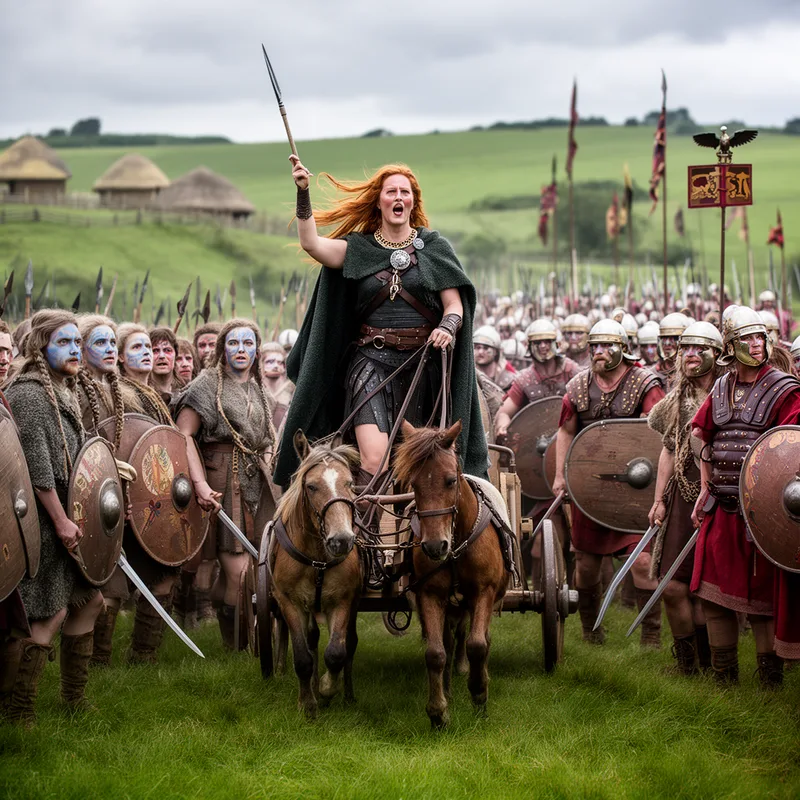
Boudicca was the famous queen who led the Iceni tribe in their revolt against the Romans.
-
The British Museum features many artifacts from the Iceni, including silver coins and decorative torcs.
Surface Forms
Etymology
The name Iceni was the tribe's own name and was recorded by Roman writers; it probably comes from an old Celtic word meaning 'people' or 'family'. A helpful way to remember the Iceni is to think of them as a strong local 'people' who rose up against Roman rule.