
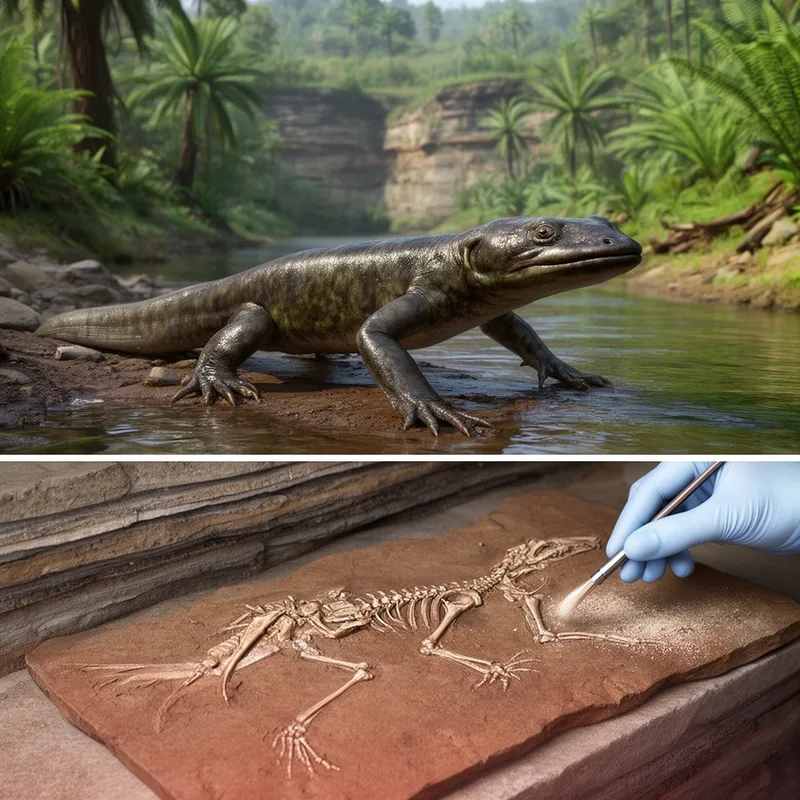
Hynerpeton bassetti
- proper noun
- Specialized
- Researchers believe that Hynerpeton bassetti had well-developed limbs suited for movement both in water and on land.
Examples
-
The fossil remains of Hynerpeton bassetti provided insights into the evolution of early tetrapods.
-
Scientists discovered Hynerpeton bassetti in Devonian rocks in Pennsylvania, suggesting the region was once a lush habitat.
-
The fossil of Hynerpeton bassetti was discovered in Pennsylvania.
-
Did you know that Hynerpeton bassetti lived during the Devonian period?
-
Researchers believe that Hynerpeton bassetti had well-developed limbs suited for movement both in water and on land.
-
Scientists discovered Hynerpeton bassetti in Devonian rocks in Pennsylvania, suggesting the region was once a lush habitat.
-
The fossil remains of Hynerpeton bassetti provided insights into the evolution of early tetrapods.
Synonyms

An extinct early amphibian known from fossils in Pennsylvania during the Devonian
Surface Forms
Morphology
Hynerpeton + bassetti
This is a scientific Latin binomial (a proper name) rather than a compositional English phrase; the label 'Hynerpeton' is a genus name and 'bassetti' is an epithet (not a lexical English word), so the meaning 'an extinct genus of early tetrapod amphibians' cannot be derived from the parts. Recognizing this sense requires specialist taxonomic/biological knowledge and familiarity with Latin naming conventions that a B1 learner who merely knows the surface constituents would not have.
Etymology
Hynerpeton bassetti comes from the place Hyner in Pennsylvania where its fossils were found and from the name bassetti honoring the person who helped discover them. The part -peton means 'creature', so the name helps you remember it was an early animal with legs that lived long ago and was found at Hyner.

