
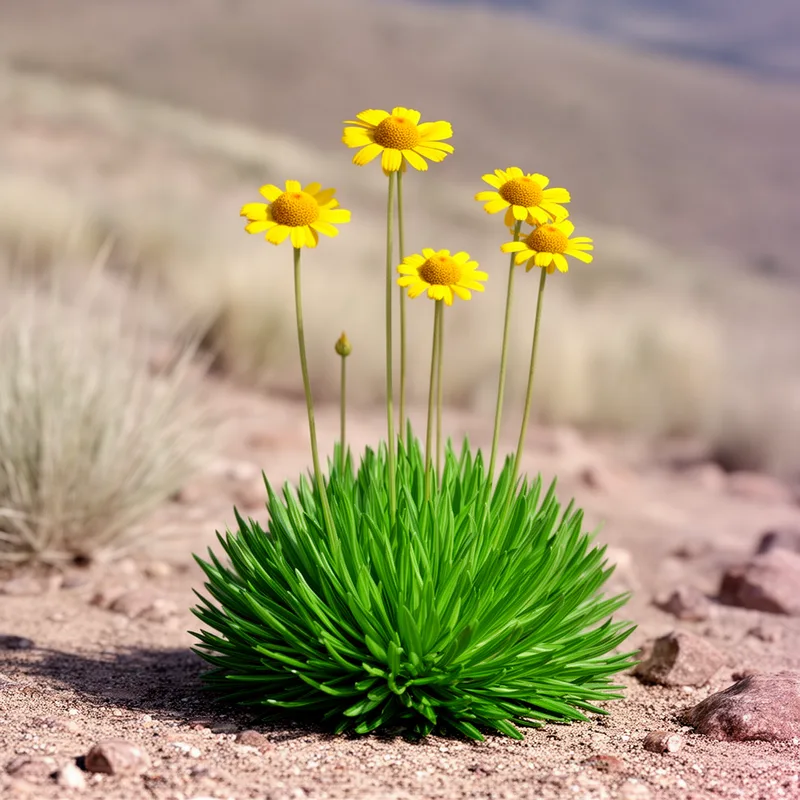
Hymenoxys acaulis
- noun
- Specialized
- The bright yellow flower heads of Hymenoxys acaulis stand out against its tufted green leaves.
Examples
-
Hymenoxys acaulis thrives on dry hillsides and open plains throughout the western United States.
-
Botanists surveyed the natural habitat of Hymenoxys acaulis to study its ecological adaptations.
-
The Hymenoxys acaulis blooms beautifully in the spring.
-
Have you seen the Hymenoxys acaulis in the garden?
-
Hymenoxys acaulis is commonly found in rocky soil and produces vibrant yellow flowers in the summer.
-
In its natural habitat, Hymenoxys acaulis can survive with minimal water, showcasing its drought-resistant traits.
-
Many gardeners appreciate Hymenoxys acaulis for its bright blooms and low maintenance needs.
Synonyms
A low plant that grows in dry rocky places in west-central North America and has short stalks with yellow flowers
A low plant that lives many years with a clump of leaves and single yellow flowers on short stalks
Surface Forms
Morphology
Hymenoxys + acaulis
This is a Latin taxonomic binomial (a scientific species name) whose constituents are not ordinary English words and have no dictionary definitions given here; a B1 learner who knows English vocabulary would not be able to derive the plant description from these forms. Scientific names are conventional labels rather than compositional phrases, so the meaning is not transparently built from the surface parts.
Etymology
Hymenoxys acaulis gives a clear picture: the second part, acaulis, means 'without a stem', so its yellow flower sits very close to the ground on a very short stalk. That's why the name points to a low, stemless plant with a single bright yellow flower head.

