
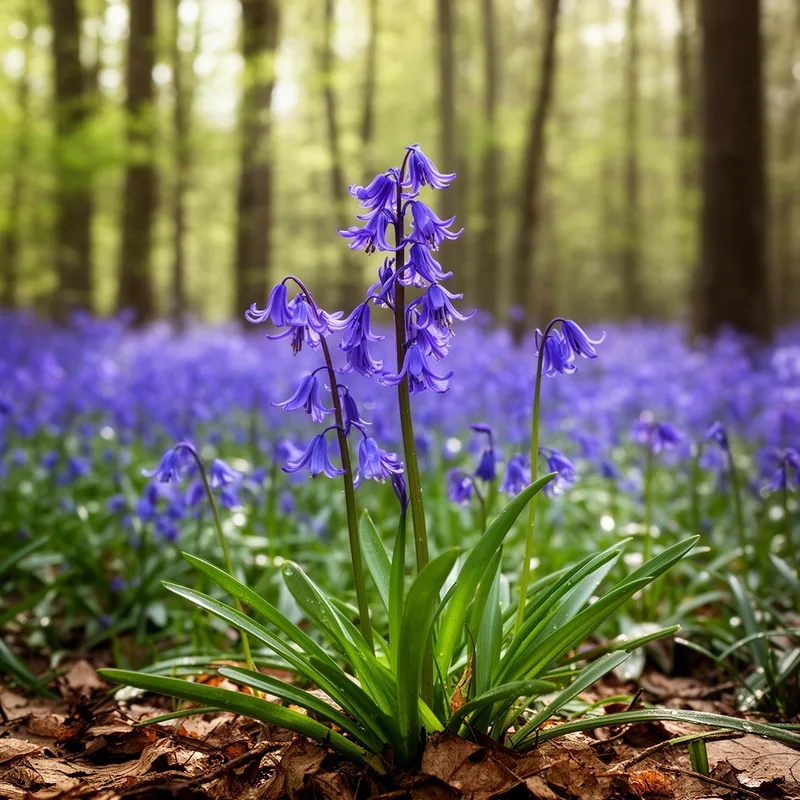
Hyacinthoides nonscripta
- noun
- Specialized
- Did you know that Hyacinthoides nonscripta is also known as the common bluebell?
Examples
-
The woodlands are carpeted with Hyacinthoides nonscripta in late spring, creating a vivid sea of blue.
-
Many British forests are famous for their displays of Hyacinthoides nonscripta each year.
-
Botanists have reclassified Hyacinthoides nonscripta several times, previously placing it in the genus Scilla.
-
The Hyacinthoides nonscripta blooms beautifully in the spring.
-
In April, the woodlands are filled with the vibrant blue flowers of Hyacinthoides nonscripta, creating a stunning sight.
-
Visitors flock to see the enchanting display of Hyacinthoides nonscripta blooming across the hills in springtime.
-
The delicate flowers of Hyacinthoides nonscripta can often be found adorning the forest floor during the warmer months.
Synonyms
 5
2.6
5
2.6

A plant with bell-shaped blue flowers that grows in woods or fields
A small bluebell plant with bell-shaped blue flowers that grows in western European woods in spring
Surface Forms
Morphology
Hyacinthoides + nonscripta
This is a Latin scientific binomial rather than a compositional English phrase; its species epithet 'nonscripta' is not an English word (and is marked as not found), so a B1 learner knowing the listed constituents would not be able to derive the common-plant meaning. Scientific names label a specific taxon and require botanical or Latin knowledge to interpret, so the meaning is not transparently built from ordinary English vocabulary.
Etymology
Hyacinthoides nonscripta comes from old Latin and Greek words: Hyacinthoides means 'hyacinth-like' because the flowers are small, bell-shaped like a hyacinth, and nonscripta means 'not written' — one popular idea says this wild flower was 'not written' in early books or had plain, 'unmarked' petals. So the name helps you remember it is the wild, bell-shaped 'bluebell' that fills woods in spring.