
Hominoidea
- noun
- /həˈmɪnəˌdɪə/
- Specialized
- The evolutionary relationships among Hominoidea have been the subject of extensive scientific research.
Examples
-
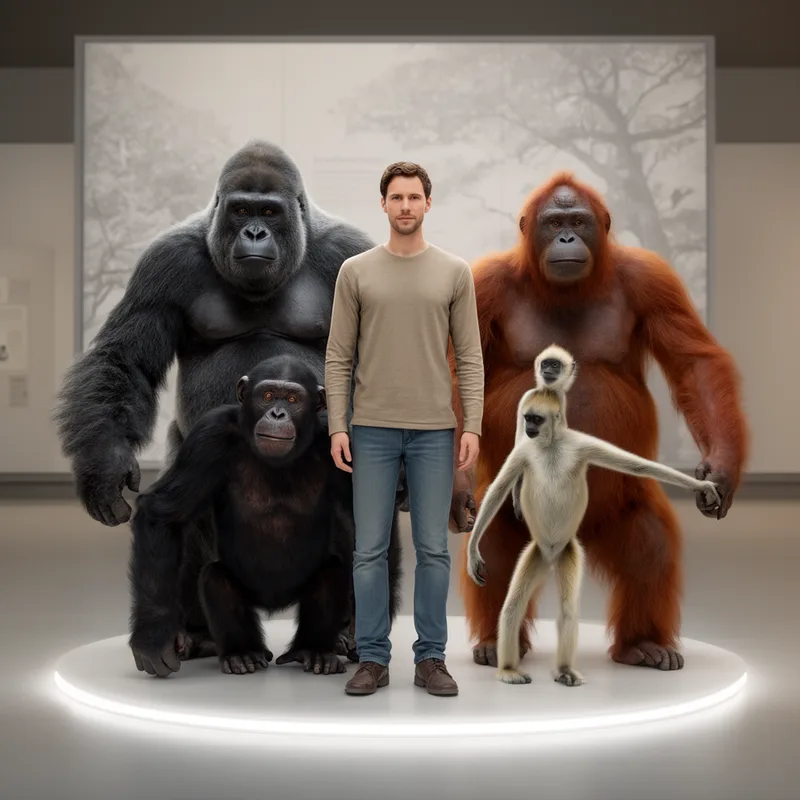
Gorillas, chimpanzees, and humans all belong to the Hominoidea superfamily.
-
Unlike monkeys, members of Hominoidea do not possess tails.
-
The Hominoidea family is fascinating.
-
Did you know Hominoidea includes humans?
-
The biological superfamily Hominoidea encompasses all species of apes, including gorillas and chimpanzees.
-
Scientists classify humans as part of Hominoidea, highlighting our close evolutionary relationship with other apes.
-
Research on Hominoidea provides insights into the cognitive abilities shared by humans and our closest relatives in the animal kingdom.
Synonyms

A group of animals that includes humans and apes
Compounds
Surface Forms
Morphology
Hominoidea = hominoid (opaque) = homin + oidea
Formed with the scientific combining stem 'homin-' and the taxonomic suffix '-oidea', a specialized construction that is not guessable by average learners.
Etymology
Hominoidea comes from the root homin- meaning 'human' and the ending -oidea meaning 'like' or 'in the form of'. So Hominoidea is the 'human-like' group of primates, which is why it includes apes and humans but not monkeys.

