

Holy Writ
 2
9.2
2
9.2

- noun
- /ˈhoʊli rɪt/
- Archaic
- Many people turn to Holy Writ for guidance in difficult times.
- proof of Holy Writ
Examples
-
Primarily, the Apocalypse can be seen as the 'climax' to all that has preceded it in Holy Writ.
Blog text (6) -
The rule was more than procedure; it was Holy Writ.
Fiction book (2001) -
You see, it is written in this holy writ.
-
Like you, brother John, I stand firm with the whole of Holy Writ, not just the parts I like.
Blog text (22) -
America turned a particular piece of English legislation into Holy Writ.
Blog text (4) -
How can you glean any benefit for your souls if you will not listen to the holy writ?
-
Most sure it is that Jude in holy writ doth warn us to maintain, and fight for it.
Fiction book (1996) -
They regard the Constitution as holy writ until they find a way to subvert it.
Blog text (16) -
Why this abundance of violence and blood in the Holy Writ of two religions whose espoused primary tenets are peace and good will toward others?
Academic text (2001) -
The popular perception of the Bible as a divinely perfect book receives scant support from Ehrman, who sees in Holy Writ ample evidence of human fallibility and ecclesiastical.
Blog text (26)
Synonyms
 178
8.4
178
8.4
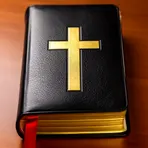
The holy book used by Christians, called the Bible
 118
7.0
118
7.0
The holy writings of the Christian religion, especially the Bible
 41
6.5
41
6.5
Sacred writings and teachings believed to come from God that give guidance for living
 12
1.3
12
1.3
A book of holy writings used by Christians
 5
6.3
5
6.3
A book or writing that people respect and use in worship in a religion
 5
3.7
5
3.7
A book or writing that people treat as holy in a religion
 5
5.2
5
5.2
Religious books of Christianity that include the Old and New Testaments
 3
7.5
3
7.5
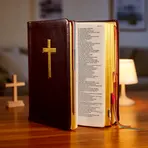
The Christian holy book used for teaching and comfort
 2
2.3
2
2.3
A collection of holy books for Christians including the Old and New Testaments
 1
7.5
1
7.5
A holy text that a religion treats as true and that guides people's lives
 1
7.7
1
7.7
A text that a religion treats as holy and important


 1
4.5
1
4.5
A text seen as holy and used for worship or teaching in a religion
How Academic

Surface Forms
Morphology
holy + Writ
The meaning 'the sacred writings' is directly and compositionally derived from 'holy' (sacred) + 'writ' (a written document), so the phrase transparently denotes sacred writings such as the Bible. Although 'writ' is archaic and low-frequency and may be unknown to many B1 learners, if a learner knows both constituent words the overall meaning is immediately predictable.
Etymology
The phrase Holy Writ uses the old word writ, which simply meant a written document, so the image is of a sacred, written book. That's why it came to mean 'sacred writings' or 'the Bible' today.