
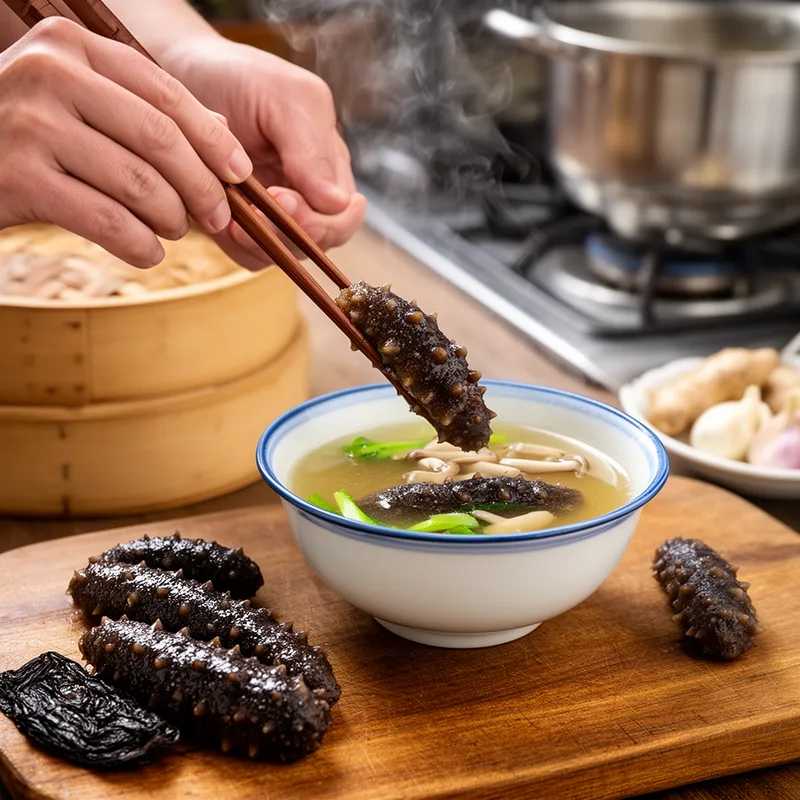
Holothuria edulis
- noun
- Specialized
- In many markets, Holothuria edulis is considered a delicacy and harvested for culinary uses.
Examples
-
Chefs often rehydrate dried Holothuria edulis before adding it to gourmet soups.
-
Many restaurants in China serve Holothuria edulis as a delicacy.
-
The waters around Thailand are home to a thriving population of Holothuria edulis.
-
Have you ever tried Holothuria edulis in a seafood dish?
-
In many markets, Holothuria edulis is considered a delicacy and harvested for culinary uses.
-
Chefs often rehydrate dried Holothuria edulis before adding it to gourmet soups.
-
Many restaurants in China serve Holothuria edulis as a delicacy.
Synonyms

 6
4.8

A soft sea animal with a long body, leathery skin, and tentacles around its mouth


 1
9.9
A sea animal with a soft, long body and tentacles near its mouth
 1
9.9
A sea animal with a soft body that people eat in East and Southeast Asia
Surface Forms
Morphology
Holothuria + edulis
The name is compositional: Holothuria denotes the sea-cucumber genus and edulis (Latin for 'edible') specifies that it is an edible species. Given those constituent meanings, the overall sense 'an edible species of Holothuria (sea cucumber)' is directly derivable from the parts, so the expression is transparent.
Etymology
Holothuria edulis gets its name from old words: Holothuria came from a Greek word for a soft, cucumber-like sea animal, and edulis is Latin for 'edible'. Picture a soft sea cucumber sold for food, and you'll see why the name points to a sea creature people 'eat' today.