
Hohokam


 1
9.9
- proper noun
- /hoʊhoʊˈkɑm/
- The Hohokam people are renowned for their impressive pottery and advanced agricultural techniques.
Examples
-
Specifically, the Hohokam of the American Southwest not only had plaster-lined canals and permanent sluice gates but also had them very early.
Academic text (1995) -
After about A.D. 1100, for reasons not fully understood, the Chaco Canyon Anasazi and Phoenix Basin Hohokam societies began to collapse.
Academic text (2004) -
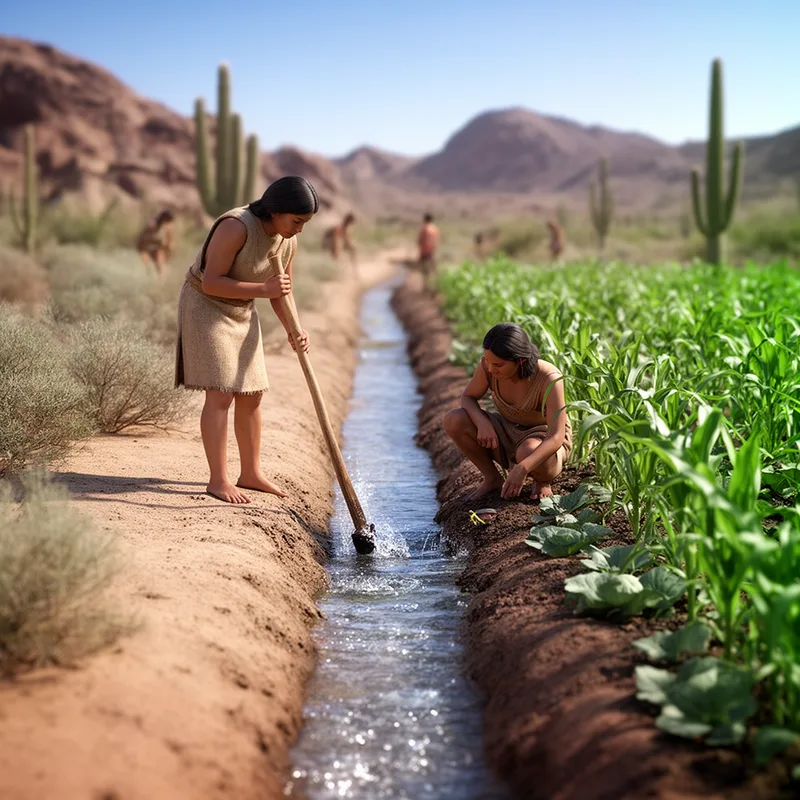
To the south were the Hohokam, who engineered hundreds of miles of canals to water their desert fields.
Academic text (2004) -
The thinking that went behind this document, however, was inspired more by indigenous customs and values, such as those handed down from the time of the Hohokam.
Academic text (2010) -
Beyond the Pueblo region, there was the remarkable Hohokam civilization in southern Arizona, and of course there were Mesoamerican cultures far to the south.
Academic text (2009) -
This area has a long history of water development, starting with the Hohokam Indians, who irrigated extensive parts of the Salt River Valley from AD 300 to 1450.
Academic text (2004) -
"Thin Leather" recalls a story about the Hohokam ruins that stand prominently near Florence, Arizona, ruins that belong to a culture as distant and mysterious to outsiders as the Anasazi ruins to the north.
Academic text (2010) -
"At the time, a distinctive irrigation culture known as the Hohokam farmed the Phoenix Basin, while part-time agriculturalists, the Mogollon people, lived in the White Mountains of east-central Arizona."
Academic text (2007) -
The Hohokam built extensive irrigation systems that transformed the arid landscape of Arizona.
-
Researchers have discovered artifacts that provide insight into the daily lives of the Hohokam.
Surface Forms
Etymology
Hohokam is the name used for an ancient people of the American Southwest, and one popular idea is that the name comes from a local Native American language meaning 'those who are gone'. That meaning helps explain why archaeologists use Hohokam for the people and their old towns and canals.