
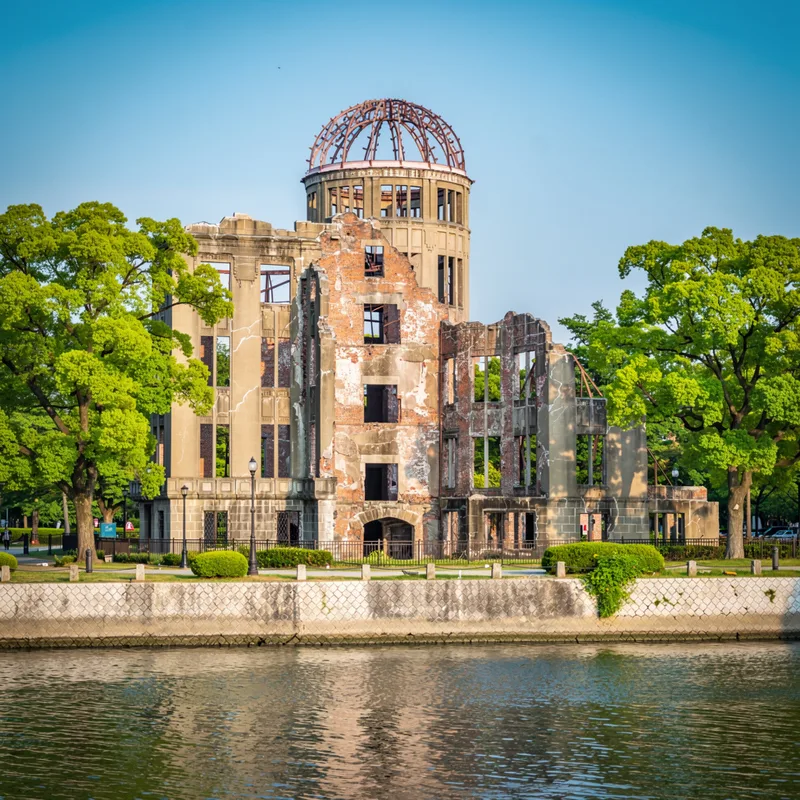
Hiroshima
 48
3.5

- proper noun
- /hɪəˈroʊʃɪmə/
- Finally, the first 4-year college course in physical and occupational therapy was started at Hiroshima University in 1992.
- Hiroshima and Nagasaki
- atomic bombing of Hiroshima
- bombing of Hiroshima
Loading YouTube…
Watch on YouTubeThis is the true story of how Hiroshima survived the atomic bomb.
- This is the true story of how Hiroshima survived the atomic bomb.
- I still have to play in Kachi and Hiroshima, but I'm not going to do that today.
- The film also doesn't show the victims in Hiroshima and Nagasaki.
- And there's a New York Times front page saying no radiation in Hiroshima after bomb.
- It was not the atom bomb that decided to bomb Hiroshima.
- An American airplane dropped one bomb on Hiroshima.
- For example, there's a piece written called the Trinity for the victims of Hiroshima.
- But I mean, this guy said, I know there's a lot of hand wringing in America about Nagasaki and Hiroshima, not in Asia.
- And that began with the Hiroshima and Nagasaki bombings, the effects of nuclear weapons on buildings and people.
- So atomic bombs, people think Hiroshima and Nagasaki, those were tiny.
- They did not stop Three Mile Island, Hiroshima, I'm sorry, Fukushima or, or Chernobyl.
- Like it's kind of comfortable that we live in the, you know, sadly in the post Hiroshima, Nagasaki world where like we've kind of come to this stable point.
Examples
-
This is the true story of how Hiroshima survived the atomic bomb.
-
I wanted to write this because I myself am the son of a Hiroshima survivor.
Fiction book (2002) -
And we also have a bell from Hiroshima to ring truly from Hiroshima for the sake of peace.
-
I wonder what the city fathers of Hiroshima would say about that.
-
Say, you were at Hiroshima, weren't you, Dad?
-
When the atom bomb hit Hiroshima in 1945, this kabukimono sword was on display there.
-
What we witness in Hiroshima, as the author tells us, is another "parade" of Hiroshima: "Children parading, students parading."
Academic text (1997) -
A pall of black destruction and chaos still hangs over Hiroshima.
-
Nine days after the bomb at Hiroshima, on August the fifteenth 1945. Emperor Hirohito announced the surrender of Japan.
-
No U.S. president has ever visited Hiroshima, the first city devastated by an atomic bomb on August 6, 1945.
Surface Forms
Etymology
Hiroshima comes from two Japanese parts: hiro meaning 'wide' and shima meaning 'island'. So the name literally says 'wide island', a simple picture that matches the city's rivers and port and helps you remember this rebuilt city that, after the 1945 atomic bomb, became a strong symbol of peace.