
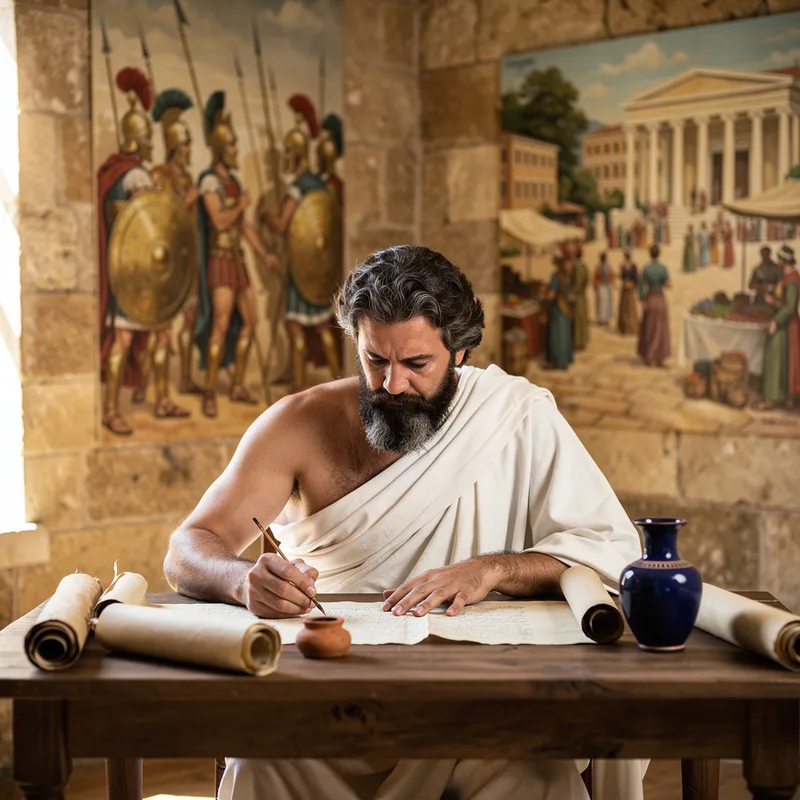
Herodotus
 6
8.6

- proper noun
- /həˈrɒdətəs/
- From the time of Herodotus, democracy has meant, first and foremost, the rule of the people.
- Herodotus, the historian
- Herodotus, the Greek historian
- Herodotus' Histories
Loading YouTube…
Watch on YouTubeThey cite the writings of Herodotus and Tacitus and inscriptions on Egyptian monuments.
- They cite the writings of Herodotus and Tacitus and inscriptions on Egyptian monuments.
- And then I took a Herodotus course and now we're learning, you know, a different dialect, right?
- Did Napoleon take Herodotus to to Egypt?
- Here is how Herodotus puts her response Quote.
Examples
-
To be educated meant to have learned and reflected upon Homer, Herodotus, Virgil, and Horace, and of course the Bible.
Academic text (1991) -
"Haste is the mother of failure," Herodotus warned the Persian King Xerxes as he was contemplating war against the Greeks.
Academic text (2011) -
Herodotus is the father of history.
-
War is studied, said Herodotus, so that the great deeds of men may not be forgotten.
Academic text (1992) -
The ancient Greek historian Herodotus called these people Scythians.
-
These natural antiseptics were described by the Greek historian Herodotus in his book.
-
According to Herodotus, he defeated King Oxyartes... ...whose daughter Roxanne he subsequently took to wife."
-
To be sure, this can sometimes be tiresome reading, and, unlike Herodotus, Strabo was not comfortable with uncertainty.
Academic text (2004) -
The authors included Herodotus, Livy, Gibbons, Tacitus, Hume, Franklin, Locke, Burke, and Middleton (Lee 1967, 149-50).
Academic text (2004) -
Herodotus is often called the 'father of history' due to his detailed accounts of ancient events.
Surface Forms
Etymology
The word Herodotus comes from ancient Greek name parts: hero (like the English 'hero') and -dotos meaning 'given'. A helpful way to remember him is 'gift of a hero' because he 'gave' stories about ancient people and wars, which is why he is called the 'father of history'.