
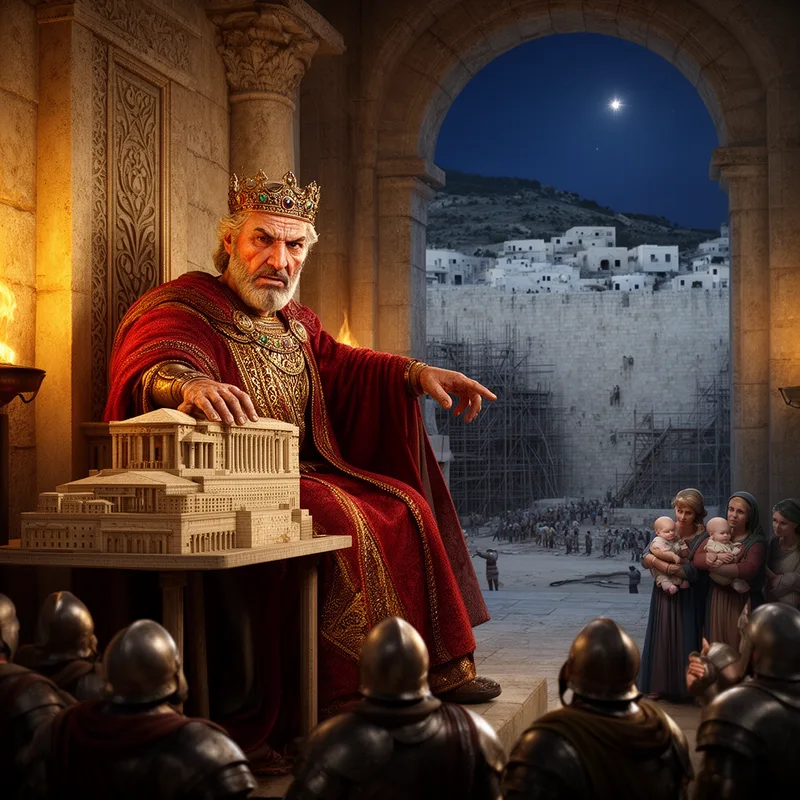
Herod the Great
 1
9.2

- proper noun
- The story of Herod the Great is central to the early chapters of the Gospel of Matthew.
Examples
-
Many ancient buildings in Judea were constructed under the reign of Herod the Great.
-
Historians debate the extent of Herod the Great's cruelty and his political achievements.
-
Herod the Great was a king.
-
Did Herod the Great really order the massacre of infants?
-
Jesus was born before the death of Herod the Great, and thus probably not later than 4 B.C.E.
-
"Herod the Great saw himself as the king of the Jews, and indeed was the reigning king."
-
In Matthew, Herod the Great orders the killing of all male infants under the age of two in Bethlehem.
Synonyms
 17
8.8
A king of Judea who orders the killing of young children in Bethlehem
Surface Forms
Morphology
The phrase is compositionally clear: a learner who knows 'Herod' (a named king) and 'great' will interpret 'Herod the Great' as the ruler Herod who is notable or historically significant. 'The Great' is a conventional epithet (cross-linguistically common) rather than an idiom, so the overall meaning is directly derivable from the constituents.
Etymology
Herod the Great gets his name from his huge building work and powerful rule; he was a 'king' who built palaces, ports, and whole cities. At the same time, the Bible says he ordered the killing of infants, so the title the Great helps you remember he was both a famous builder and a cruel ruler.