
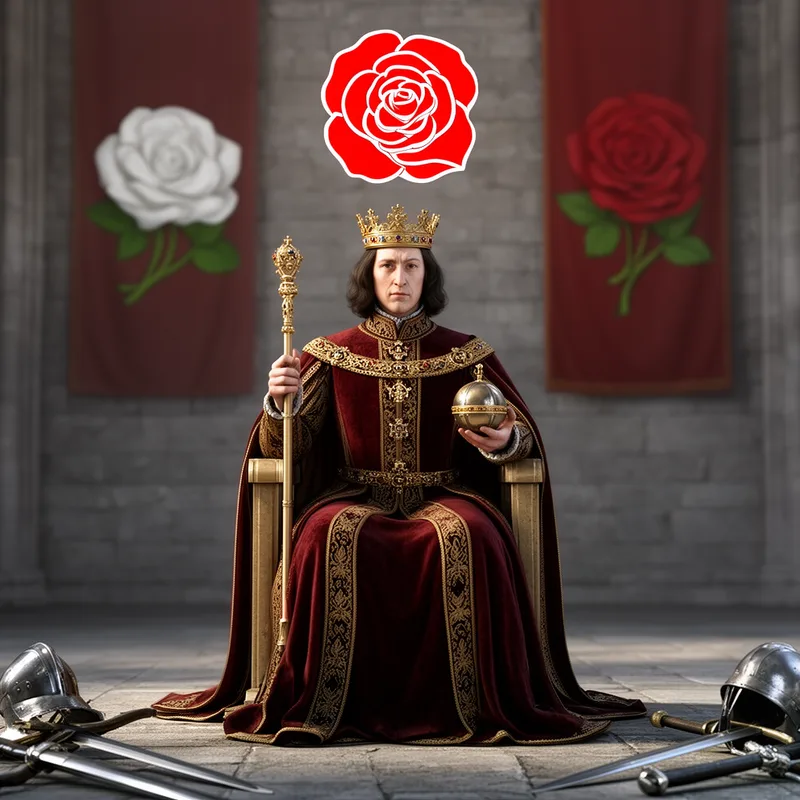
Henry VII
 1
6.3

- proper noun
- King Henry VII established the Tudor dynasty.
Examples
-
The marriage of Henry VII to Elizabeth of York helped to end the dynastic conflict known as the Wars of the Roses.
-
The marriage of Henry VII to Elizabeth of York helped to end the dynastic conflict known as the Wars of the Roses.
-
Henry VII established a strong central government after decades of civil war in England.
-
After defeating Richard III at the Battle of Bosworth, Henry VII was crowned king in 1485.
-
Did Henry VII really end the Wars of the Roses?
-
Henry VII established a strong central government after decades of civil war in England.
-
After defeating Richard III at the Battle of Bosworth, Henry VII was crowned king in 1485.
Synonyms


 1
6.5
An English king who ends the Wars of the Roses and unites York and Lancaster by marrying Elizabeth of York
 1
6.5
A king of England who ended the civil war by defeating Richard III and marrying Elizabeth of York
Surface Forms
Morphology
Henry + VII
Knowing 'Henry' (a personal name) and 'VII' (the numeral seven) lets a learner infer this refers to 'Henry the Seventh' and, if familiar with monarch numbering, that it names a specific ruler; however the detailed historical identity (first Tudor king who ended the Wars of the Roses) cannot be derived from the constituents alone and requires encyclopedic knowledge. Because part of the meaning (a specific monarch) is transparent but the full referential/historical content is not, this is best classed as semi-transparent.
Etymology
Henry VII was the first Tudor king of England. He won at Bosworth and married Elizabeth of York to join the houses of York and Lancaster, so he ended the long civil war. So his name is remembered for 'bringing peace' and 'starting a new royal line'.