
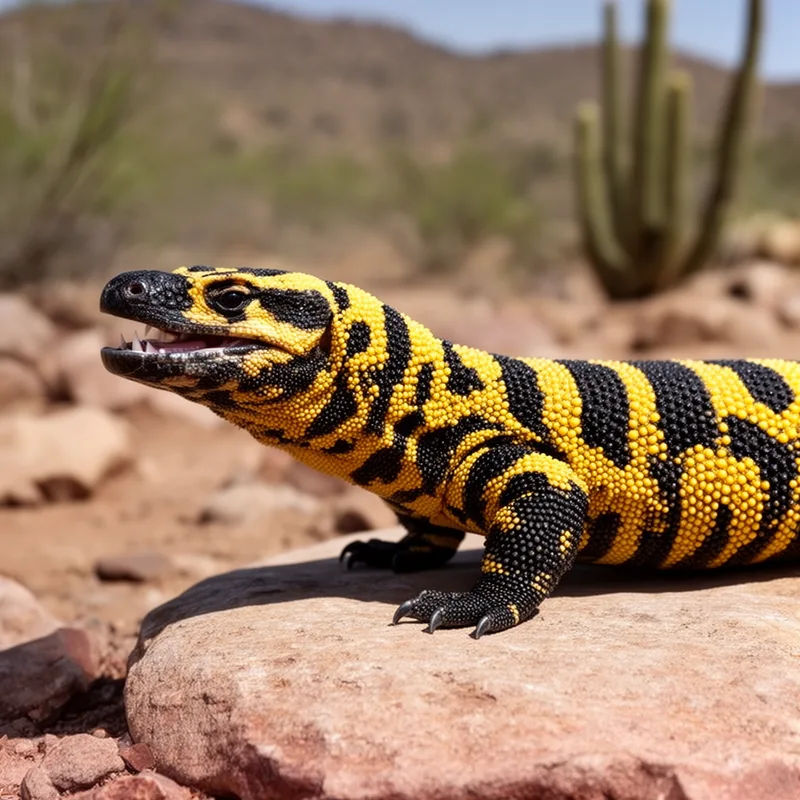
Heloderma horridum
- noun
- Specialized
- The Heloderma horridum is also known as the Mexican beaded lizard.
Examples
-
The Heloderma horridum is easily recognized by its striking yellow and black beadlike scales.
-
The Heloderma horridum is one of only a few venomous lizard species in the world.
-
Researchers studied the habitat of the Heloderma horridum in western Mexico.
-
The Heloderma horridum has beadlike scales that are both distinctive and functional.
-
Did you know that the Heloderma horridum can be quite aggressive?
-
In western Mexico, the Heloderma horridum uses its venom to hunt small prey.
-
Many people are surprised to learn that the Heloderma horridum can deliver a painful bite.
Synonyms

A large lizard from western Mexico with shiny black and yellow bead-like scales and a venomous bite
A large lizard from western Mexico that can give a dangerous bite and has small round scales like beads
Surface Forms
Morphology
Heloderma + horridum
This is a Latin binomial scientific name (genus + species) rather than an ordinary English phrase; the species epithet 'horridum' is not an English word and the meaning 'venomous lizard' depends on taxonomic knowledge. Even if a learner knows that Heloderma refers to Gila monsters/beaded lizards, understanding the full referent requires specialized biological or Latin knowledge beyond B1 vocabulary, so the meaning is not derivable from the parts.
Etymology
Heloderma horridum comes from old Greek and Latin: Heloderma means 'studded skin' and horridum means 'rough' or 'dreadful'. The name points to the lizard's hard, beadlike scales and its dangerous, venomous nature, so it fits this species today.

