
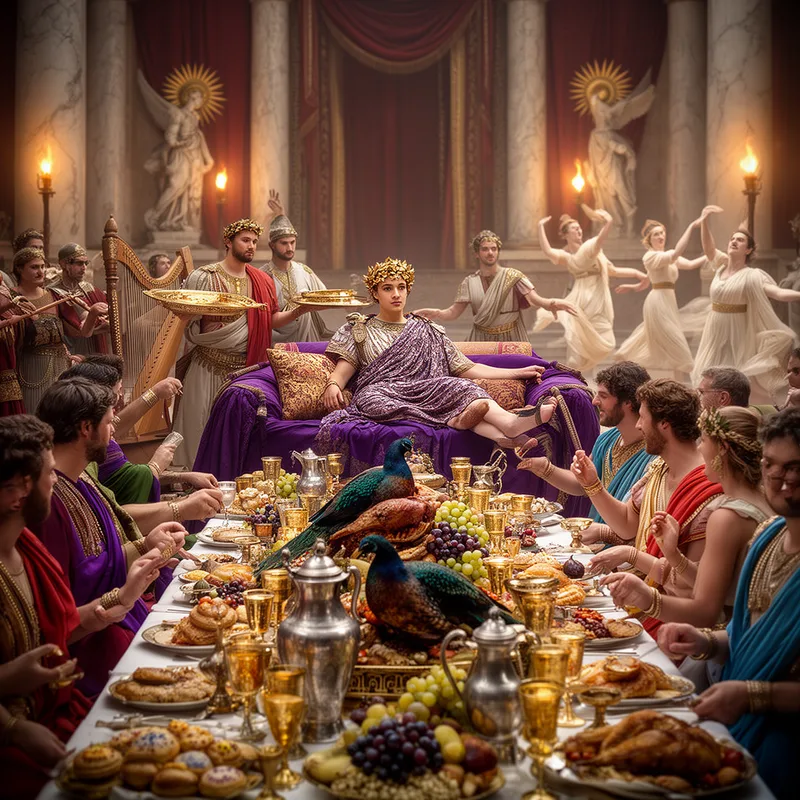
Heliogabalian festival
- noun
- /ˌhiːliəˈɡeɪbeɪliən ˈfɛstəvəl/
- During the Heliogabalian festival, guests feasted and celebrated with elaborate performances.
Examples
-
The city museum recreated a Heliogabalian festival to showcase the lavish customs of ancient Rome.
-
The Heliogabalian festival was renowned for its lavish celebrations.
-
Scholars debate whether the original Heliogabalian festival was a religious or primarily secular event.
-
Many historians study the Heliogabalian festivals to understand Roman decadence.
-
The city museum recreated a Heliogabalian festival to showcase the lavish customs of ancient Rome.
-
During the Heliogabalian festival, guests feasted and celebrated with elaborate performances.
-
Many historians study the Heliogabalian festival to understand Roman decadence.
Synonyms

 1
9.9
1
9.9

A Roman festival with loud feasting when people often switch social roles

 1
9.9
1
9.9
An ancient festival of wild dancing and drinking to honor Bacchus
How Extravagant

Surface Forms
Morphology
The phrase is a straightforward adjective+noun composition: 'Heliogabalian' means 'relating to Heliogabalus' and 'festival' means a celebratory event, so the combined meaning ('a festival associated with Heliogabalus or his practices') is directly derivable. Although culturally specific and potentially rare, the semantic relation is compositional and predictable for a learner who knows both constituent words.
Etymology
Heliogabalian festival may come from the Roman emperor Heliogabalus, who held very rich, showy parties with gold, music and wild performances to honor a sun god. So, Heliogabalian festival is used today for a celebration that is 'very lavish' or 'over the top'.